
Carbon Management Solutions
Table of Contents
- What are Carbon Management solutions?
- How Carbon Management solutions factor into the S2P process
- Why Carbon Management solutions are important
- Common features of Carbon Management technology
- Carbon Management use cases
- How technology supports Carbon Management – Top 4 capabilities
- Why selecting Carbon Management technology can be difficult
- Discover Carbon Management vendors
An In-Depth Guide
What are Carbon Management solutions?
Carbon management solutions are designed to assist companies in reducing their carbon footprint, usually taking into consideration the emissions of carbon dioxide (CO2). Platforms that offer carbon management solutions usually begin with data intake. This data can then be enhanced by the solution, with data coming directly from companies along the value chain to identify emissions hotspots.
The amount of support needed in this process determines the solution provider a user chooses. Platform support can range from basic emission coverage to granular insights, depending on user needs.
Since carbon management is a relatively new concern for many companies, implementing a carbon management solution can be beneficial for internal and external success. Many organizations might struggle to track emissions themselves due to a lack of in-house expertise, time constraints or the cost of hiring specialized staff. A carbon management platform can thus be used to provide valuable insights and best practices, delivering the necessary guidance and support without the expense of a full-time hire.
Platforms that offer carbon management solutions often begin by calculating a company’s current footprint using various methodologies (depending on the data that is available, the solution’s capability, etc.). Following that step, solutions will provide insights into where users can reduce emissions. The compliance and regulations a company must adhere to will impact the recommendations provided to them. For instance, companies within the EU’s jurisdiction have stricter regulations (than in the US, for example) and will have to adjust their carbon tracking and management accordingly. Most of these platforms are well-versed in the various regulations that exist and provide the necessary tracking and recommendations to ensure compliance.
Overview of GHG Protocol scopes and emissions across the value chain
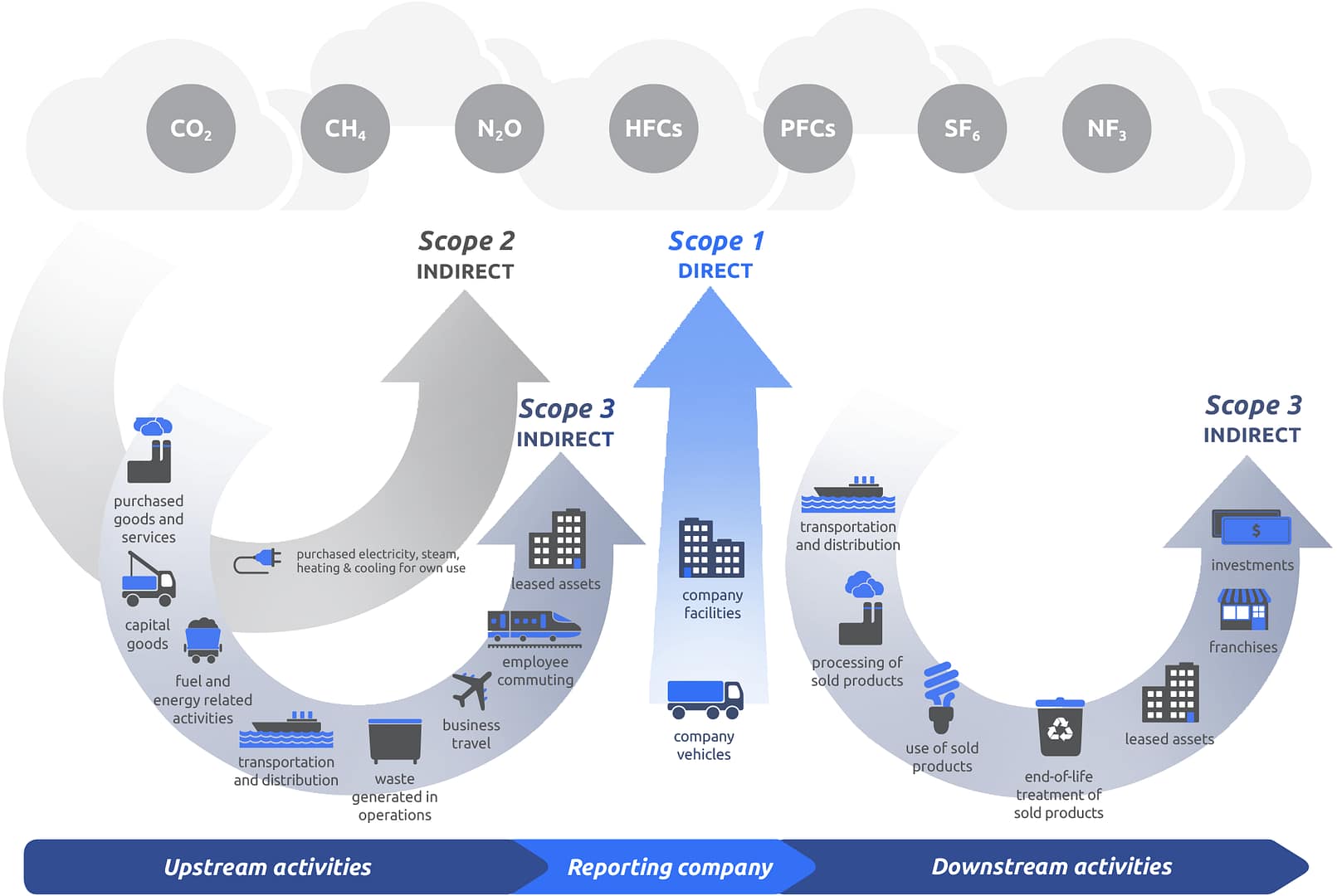
Emissions are categorized into Scope 1, Scope 2 and Scope 3, according to the Greenhouse Gas (GHG) Protocol. Scope 1 emissions are those directly controlled by a company, such as those from its own facilities and vehicles. Scope 2 emissions are associated with the energy purchased by the company, like electricity for its buildings. These, therefore, are theoretically possible to track in-house (though, as previously mentioned, many companies do not have the bandwidth to do so).
Scope 3 emissions, however, are more challenging to manage. These are indirect emissions that occur in a company’s value chain, including both upstream and downstream activities, and are not directly produced by the company itself. This makes them harder to track and manage because the company has limited visibility and control over the production processes of its suppliers.
Looking at procurement’s role and impact in carbon management, tracking upstream Scope 3 emissions involves collecting data from suppliers, which can be complex due to the extensive and layered nature of supply chains. As more suppliers provide their emissions data, the total scope of emissions identified grows, often revealing additional emissions from further down the supply chain, a concept rather like the un-layering of Russian nesting dolls. Despite these challenges, understanding and managing Scope 3 emissions is crucial for a comprehensive approach to reducing a company’s overall carbon footprint. Scope 3 emissions in the upstream have been identified as the majority of emissions for industrial companies.
As such, partnering with a carbon management solution provider allows for more effective tracking and reduction of emissions, especially Scope 3.
How Carbon Management solutions factor into the S2P process
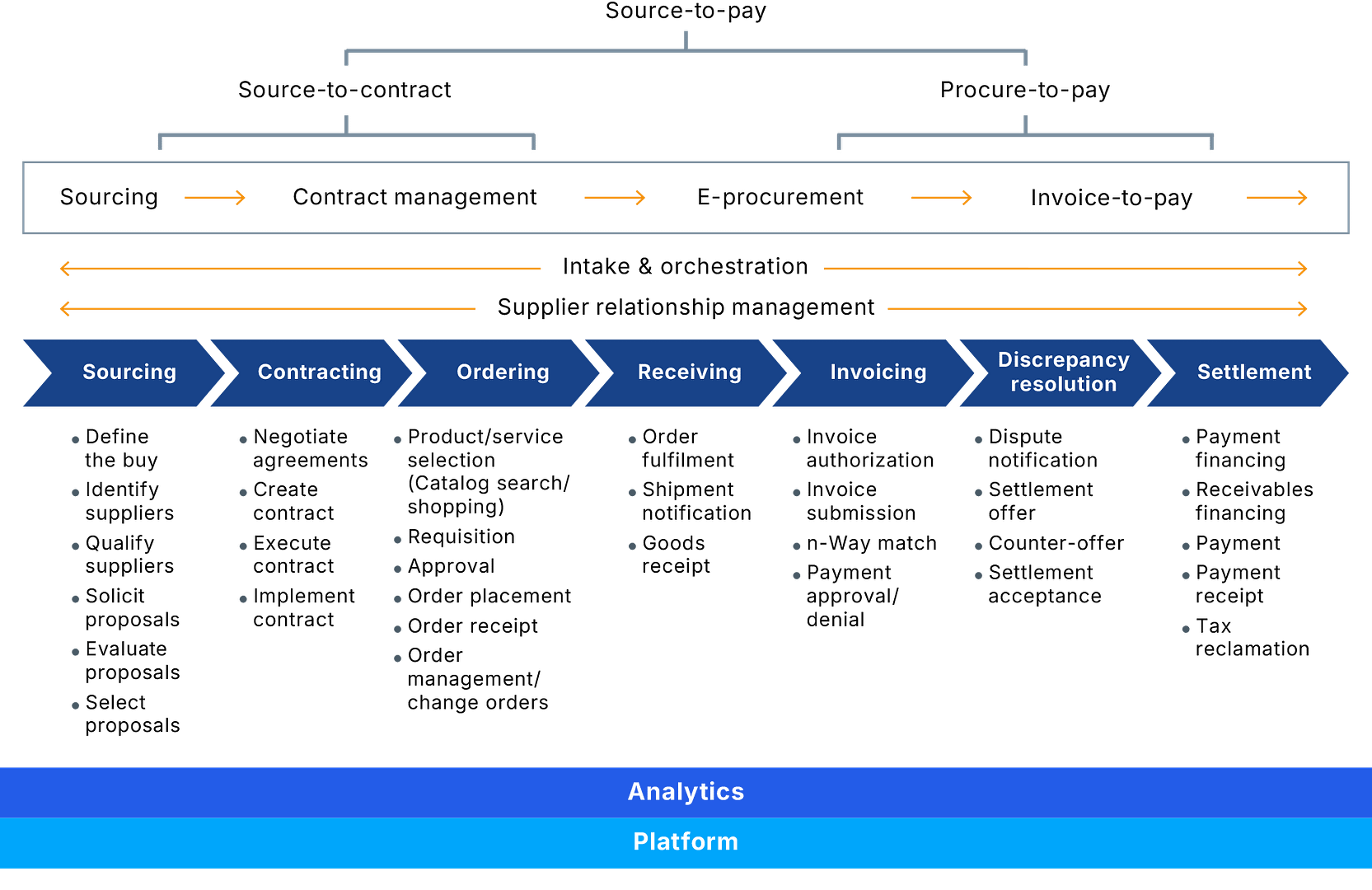
The management of CO2 emissions impacts the S2P processes at almost every step. For example:
- Carbon management solutions play a dual role in sourcing, functioning both as an input and an output. As an input, CO2 considerations should be integrated into the RFx selection process to influence award decisions. Additionally, sourcing processes themselves contribute to carbon management by including emissions data in supplier quotes. This information can later be used to calculate overall emissions, thereby enhancing the carbon management strategy.
- E-procurement, like sourcing, is affected by emissions in both input and output. For example, CO2 can be displayed during requests to show the CO2-friendliness of a specific product, so carbon-neutral products can be favored, prioritized, etc. In short, CO2 information can drive responsible buying. Then, based on the PR/PO/invoice, CO2 accounting can take place.
- For supplier management, CO2 emissions platforms inform companies of suppliers’ products, location and ethics as well the potential carbon impact after selection. Some platforms will also support suppliers in reducing their carbon footprint.
So, while carbon emissions tracking is not a core part of the S2P process, it is important to the overall compliance practices of any procurement department.
Why Carbon Management solutions are important
Since CO2 emissions affect both personal and planetary health, carbon management regulation has become increasingly important and strict. Federal organizations, such as the Securities and Exchange Commission (SEC), and the EU require companies to report their carbon emissions along the value chain. Tracking and investigating ways to reduce emissions can help companies search for alternative suppliers or transportation methods and identify cost savings.
Implementing a carbon management solution that contains expert knowledge of industry standards and benchmarks can be invaluable to an organization’s success in its decarbonization journey. These solutions can also be extremely helpful for organizations new to the industry standards.
How do I know my organization is ready for a Carbon Management solution?
As regulations are becoming increasingly stricter and more numerous, implementing carbon management solutions in advance of their introduction can keep a company a step ahead.
Companies may consider carbon management solutions for external and internal reasons. From an external perspective, a company might be concerned with compliance issues. For instance, companies located within the EU are subject to stricter regulations that require them to report on and reduce greenhouse gas emissions. Outside of the EU, other regulating bodies include, but are not limited to, The Environmental Protection Agency (EPA), the Securities and Exchange Commission and The Non-Financial Reporting Directive (NFRD). So it’s especially important to use a solution provider that keeps up-to-date with changing regulations to avoid fees and fines.
From the internal perspective of image and branding, customers are becoming increasingly concerned with where and how the products they buy are being sourced. Investors and competitors recognize this and are investing in CO2 solutions. So working towards carbon neutrality can not only fit market trends but attract more customers.
C-suite individuals have also begun to recognize the cost savings that can be gained from carbon footprint reduction. Renewable energy sources like solar, wind, hydro and geothermal power tend to have high start-up fees, but once implemented use less energy and thus lower the cost of energy bills, and ultimately production costs.
Some signs that it’s time to step in with a carbon management solution might be:
- Your organization needs to be compliant with existing or upcoming CO2 regulations.
- Your organization needs to stay up to date with changes in regulations.
- Your company has reduction targets that you contribute to.
- Your customers are pushing for emissions reduction.
- You need to identify emissions hotspots and ways to reduce them.
Common features of Carbon Management technology
Carbon management technology will incorporate several aspects of data intake and analysis.
Data collection
- Solutions will provide a platform for users to upload their data. Many platforms offer integration with supplier management portals, allowing them to upload their data as well. This will come into play during the next step.
Carbon accounting
- There are different approaches to carbon accounting depending on the granularity of data available, the amount of time to dedicate to the task and the desired level of accuracy and granularity:
- Spend-based: This method uses secondary data i.e., financial data such as invoices, travel expenses, etc. Emissions are then calculated by multiplying spend (currency amount) by an emissions factor (x kg of CO2 per EUR or USD). The benefits of this approach are that the information is readily available and requires minimum data collection. It is a great exercise for identifying emissions hotspots. However, it isn’t the most accurate as spend is not directly correlated to emissions (price fluctuations impact spend).
- Quantity-based: This process also uses secondary data but is instead quantified by identifying ‘mass’ (quantity of processed goods purchased, distance traveled or units of product sold) that is multiplied by an emission factor (x kg of CO2 per ‘unit’). It is more accurate than the spend-based methodology because it is directly linked to a quantity, but requires the information (qty) to be reported.
- To deepen the scope of carbon accounting, primary data can be collected from suppliers. This will provide more accurate data on emissions compared to the spend- and quantity-based approaches.
- The hybrid approach (secondary and primary data) utilizes data collected directly from suppliers to supplement any missing information from the quantity- or spend-based approaches. When there is a low emission category, spend- or quantity-based approaches can provide most of the information necessary for calculation, and any missing information can be added by suppliers. This method provides platforms with the necessary data to make a recommendation.
Analytics
- Dashboard and reports tailored to CO2 including emission breakdowns, actual vs target, financial evaluations, etc.
- What-if analysis
Recommendations
- Suggests value chain options that will reduce carbon emissions, from localizing supply chains to switching suppliers. It may also include product-level suggestions (e.g. switch raw material)
- Recommendations for the buyer side and the supplier side
- Library of best practices
- Benchmarks
Carbon Management use cases
Main use cases include:
- Footprint calculations: used to estimate emissions (using various methodologies and data sources) and identify ‘hotspots.’
- Identify opportunities: used to reduce emissions based on benchmarking and/or best practices.
- Develop a decarbonization strategy and action pipeline: based on the current footprint, identified opportunities and potential target reductions and commitments.
- Collaborate internally and externally on decarbonization actions: to ensure proper and timely execution and report or communicate externally.
How technology supports Carbon Management – Top 4 capabilities
The Top 4 capabilities are the highest-weighted critical capabilities that are central to the displayed solution market benchmark. They have been developed by our Solution Intelligence team of analysts and refined by procurement users in tech-selection projects that use our market-proven SolutionMap benchmarking dataset and associated TechMatch decision-making tool.
These Top 4 critical digital capabilities stem from the TechMatch workbench — derived from a larger number of requirements scored in the SolutionMap solution benchmark.
Top 4 Carbon Management (CO2) tech capabilities
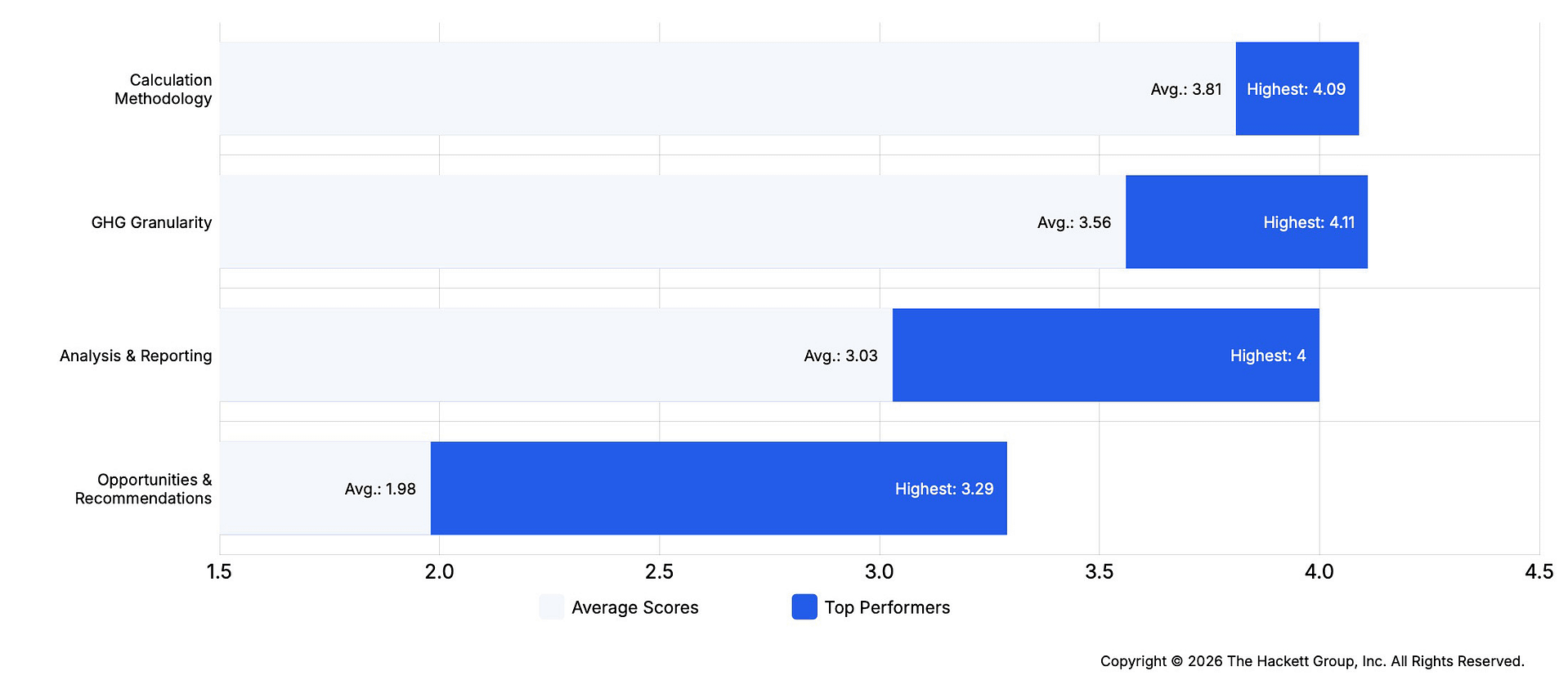
1. Calculation methodology

As discussed previously, calculating carbon emissions is incredibly important to understanding the scope of a business’ carbon footprint.
Spend-based calculations use secondary data which requires a lot less effort on the company’s behalf. However, the calculations are limited by the scope of information. Activity-based solutions rely on primary data providing a more proficient breadth and depth of information. Top-performing vendors will offer the hybrid approach, using mainly advanced techniques and supplemented with the basic method.
2. GHG granularity

Calculating GHG emissions can require a lot of information that may not be easily accessed.
The dataset is based on more basic information such as spend and the Bill of Materials (BoM). More specific data is calculated from emissions, the environmental impacts of extraction of raw materials, location, machines used, etc. The top-performing vendors have granular data models that allow customers to calculate emissions as accurately as possible.
3. Analysis and reporting

Carbon management vendors offer a range of analyses to identify emission categories and provide visual representation of their carbon spend.
Average-performing vendors provide basic templates to report GHG emissions and can be further filtered into category, region, supplier, etc. Top-performing vendors tend to have comprehensive templates that cover a more extensive number of emissions and drivers accompanied by analytics capabilities. For example, certain solutions allow customers to build new KPIs and scorecards that include GHG and other metrics to measure progress against targets and integrate GHG in other reports and analyses.
4. Opportunities and recommendations

Many solution providers offer carbon emissions and spend-saving opportunities.
Average-performing providers can identify opportunities based on industry or category emission averages. These will be expressed via templates or suggestion plans. Top performers provide customers with tailored analysis and recommendations based on their actual footprint, granular community and benchmarks, etc. Some providers focus on benchmark recommendations while others present decarbonization solutions.
Why selecting Carbon Management technology can be difficult
Choosing a solution can be difficult for a variety of reasons. Below we have highlighted the most important factors to consider when selecting a carbon management solution:
Evolving regulations: Understanding buy-side requirements and corresponding capabilities to ensure compliance can be difficult. On top of that, the regulatory landscape is constantly changing without consistency in international and standardized accounting approaches. Choosing a solution that will stay on top of the regulations and contact you about each change is an important consideration.
Changing market: Figuring out what each vendor actually covers (such as footprint, target setting, decarbonization, etc.) in an evolving market can be challenging. Assessing emerging offerings and identifying leaders with innovative ideas to keep pace with market changes can significantly influence platform selection, presenting both risks and opportunities.
The right analytics: Considering each solution offers a different analytical focus and tool, selecting a solution can prove to be a daunting task. This is why identifying a company’s area of opportunity to improve and create business value is incredibly important before solution selection occurs.
How The Hackett Group® can help you select Carbon Management technology
The Hackett Group® Solution Intelligence team specializes in procurement technology diligence. In addition to projects and advisory, we offer Procurement Technology Intelligence Program Membership, the only membership community and technology comparison tool of its kind, with access to our SolutionMap vendor rankings dataset combined with independent, zero pay-to-play, brutally honest coverage of solution providers, market developments and trends affecting procurement, finance and supply chain. We can help you identify which solutions will enable you to:
- Estimate emission footprints related to the purchase of goods and services (e.g., Scope 3 emissions)
- Prioritize areas for decarbonization, levers and actions throughout your supply chain
- Set emissions-reduction targets, collaborate with suppliers to reach them and report on progress to diverse stakeholder groups
Discover Carbon Management vendors
The following vendors are those we currently cover (or will do soon) and which include support for Scope 3 (some do more). Visit their vendor directory pages for a quick vendor overview, demographic information and relevant articles, including vendor analyses.
| Solution Provider | What it does |
|---|---|
| AnyData Solutions | AnyData Solutions, which primarily targets spend analytics, supplier management and contract management, also offers ESG tracking capabilities. The solution can assign conversion factors to spend to determine carbon outputs, supporting users’ carbon management needs. |
| Anvil Analytical | Anvil Analytical is a SaaS product offering a range of solutions. It addresses pain points surrounding visibility of spend, savings opportunities realization, visibility of carbon and risks into the supply chain, alongside the lack of visibility of inflation and spend outside of contract. |
| apexanalytix | apexanalytix covers multiple areas, focusing on financial risk and fraud detection solutions for supplier management. In 2023, it acquired ESG Enterprise, and is now able to collect evidence from a supplier, validate it, and present organizations with a true view of its supply chains’ ESG factors. |
| BCG | BCG supports clients in adjusting their business principles to adhere to ESG regulations. Consultants support companies in identifying climate innovation areas and where clients can choose green alternatives. Through its CO2 AI solution, companies can assess their carbon emissions hotspots. |
| Carbmee | Carbmee focuses specifically on carbon footprint calculation and managing emissions reduction plans with suppliers. The solution calculates Scope 3 emissions using a bottom-up approach (material-based method) or, where supplier data/knowledge is insufficient (e.g., unknown mass of a specific item/good), makes recommendations based on plausible averages, which can later be overridden by users as needed. |
| Certa | Certa provides many solutions that target ESG through third-party risk, supplier and contract management. It supports data intake which allows the platform to identify Scope 3 emissions hotspots. It also focuses on risk mitigation as an organization and uses its knowledge to supplement ESG improvements. |
| Circularise | Circularise provides a blockchain-based traceability solution that helps companies trace products and materials to verify their origins, certificates, CO2 footprints and other material data. It aims to improve resource use, provenance verification, carbon footprint estimates and impact assessments. |
| Circulor | Circulor is a traceability solution built to track materials that change physical and chemical states and that cannot be either tagged or managed at batch-level. It provides a tool that can attribute carbon use throughout the tracking process. |
| Daato | Daato Technologies aims to streamline the reporting process for companies, especially in the EU, by providing a comprehensive solution for sustainability and ESG management. |
| EcoVadis | EcoVadis emphasizes providing reliable, globally recognized sustainability ratings and insights, enabling all companies to reduce risk, drive improvement and accelerate positive impact on the planet and society. Its solution provides supplier management capabilities in addition to Scope 3 reduction targets. |
| GEP | GEP is an S2P full suite that can also implement a sustainability application called GEP GREEN which supports ESG management, analytics, strategy, development and internal collaboration. Users mainly use the solution for initial footprinting to identify CO2 hotspots. |
| Ignite Procurement | Ignite Procurement offers solutions in spend analytics, supplier management and carbon accounting. It focuses on Scope 3 emissions through a spend-based methodology and supplements it with an activity-based approach. |
| IntegrityNext | IntegrityNext provides a supplier monitoring platform that monitors a company’s direct supply base. This data collection allows it to support third-party risk solutions and carbon emissions tracking. The platform supports a Scope 3 emissions calculator to help less mature suppliers determine the extent of their indirect emissions. |
| Ivalua | Ivalua offers an extensive set of source-to-pay suite capabilities with a broad range of sourcing and procurement functionalities. Ivalua’s Environmental Impact Center (EIC) focuses on using data to generate emission baselines to help users with emissions reduction initiatives. |
| ivoflow | ivoflow is a direct spend management solution that includes a carbon footprint calculator. It leverages data from ‘sustamize,’ a sustainability platform that helps businesses and organizations reduce their carbon footprint. |
| Kodiak Hub | Kodiak Hub is a solution at the crossroads of supplier management and supplier risk with use cases for carbon management. While it does not compute carbon footprint, its templates (assessments and KPIs) can be beneficial to organizations looking for an extra push into carbon management. |
| Pando | Pando is an AI-powered platform that assists with freight and logistics needs. It supports manufacturers and retailers in submitting purchase orders, reducing carbon footprint and reducing freight costs through a unified platform. |
| Procurant | Procurant provides the perishable goods market with a solution to coordinate efforts between buyers and sellers to ensure products arrive quickly and intact. It mitigates travel complexities to help lower carbon emissions. |
| Requis | Requis is a solution built primarily to support engineering, procurement and construction management companies to source and buy more efficiently and effectively. It does this by collaborating with companies across the value chain and evaluating the most sustainable methods to meet business needs. |
| Robobai | Robobai integrates the internal aspects of supplier management, such as their contracts and transactions, with the external aspects, such as third-party risk and intelligence feeds. It utilizes this information to support ESG compliance and carbon emissions/footprint tracking. |
| Sievo | Sievo offers a service-based analytics solution that provides data management, metadata management and savings program management. This allows it to blend sustainability, diversity and risk data with a customer’s spend data via third-party partnerships and, therefore, help customers lower their carbon footprint. |
| Simfoni | Simfoni offers solutions for spend data and its impact on ESG. Its solutions help users identify excessive spend and supply chain strategies to reduce carbon emissions. |
| Spendscape by McKinsey | McKinsey’s Spendscape supports clients and industries in decarbonizing. It provides support for different combinable calculation methodologies (spend-based, quantity-based, supplier-specific data), includes an extensive library (IP) of emission factors and levers, and has a marginal abatement cost curve (MACC) that shows the costs or savings expected from different decarbonization opportunities. |
| SupplHi | SupplHi offers extensive capabilities across the supplier-management cycle that help customers perform scouting, qualifications, performance evaluations, monitoring of ESG and operational performances, and calculate the GHG emissions of their supplier base within Scope 3. |
| Sustainabill | Sustainabill helps companies understand their supply chains and thus manage risks to achieve social compliance and mitigate climate impacts. |
| Trax | Trax offers a transportation spend management solution that also covers carbon tracking. This enables customers to calculate their carbon emissions for all modes and regions globally and ensure they comply with European standards. |
| Vendigital | Vendigital aims to achieve measurable and sustainable cost reduction for clients. Consultants are able to build dashboards that track certain ESF factors, such as carbon emissions over time. |
Related Insights

Beyond CLM: Why Third-Party Risk and Contract Management Must Operate as One
Contract management and supplier management are critical aspects of the source-to-pay (S2P) process, and there is significant overlap between the…

AP Automation/Invoice-to-Pay Solutions
Accounts Payable (AP) /Invoice-to-Pay (I2P) automation software is designed to streamline AP processes within organizations by automating the receipt, processing…

Contract Management Solutions
Contract lifecycle management (CLM) solutions are systems that automate the authoring, negotiation, execution, implementation, monitoring and renewal of B2B contracts…

Risk Management Solutions
In today’s volatile business environment, the importance of risk management in procurement and supply chain management cannot be overstated. Recent…