
Procurement KPIs (Part 3) – The ‘Keys’ That Unlock the Value of Spend and Supply Management
Parts 1 and 2 of this series on procurement KPIs highlighted some of the foundational measurements for procurement pros and how traditional procurement key performance indicators can be incomplete, misleading and even damaging to a value chain transformation. In fact, one of the easiest ways to assess an organization’s buy-side sophistication is to review its portfolio of metrics. If all you see is a myopic focus on low operating expenses and a heavy one on year-over-year cost savings, you know the organization is not taking a holistic approach that maximizes enterprise value.
So how do you get from tactical procurement metrics to more powerful spend/supply measures that help build new capabilities and favorably impact critical business outcomes?
In the previous installment of this series, we mentioned some of the more expansive sets of metrics that organizations use to measure:
- Spend/cost management and savings
- Supplier/supply performance
- S2P process metrics for process performance (e.g., labor efficiency, cycle time, error rates, etc.)
- Underlying capabilities in talent management, digital, etc.
- Stakeholder-specific metrics related to their spend, their business objectives, their view into supply/supplier performance, and their assessment of procurement value add
In this installment, we dive a little deeper into the metrics and show how to use the metrics to align processes and stakeholders and accelerate a transformation. As part of this, we shall provide a little more precision to the management concepts below so that they can be aligned and accelerated:
- Value management (and performance management)
- Financial/budget management
- Demand management
- Cost management
- Savings management
- Service management
- Stakeholder management
- Spend management
- Supply management
- Process management (e.g., S2P management)
- Procurement management
- Category management
- Sourcing management
- Supplier management (or “third-party management” more broadly)
- Contract management
- Performance management
- Capability management
- Transformation management
Framing our KPIs
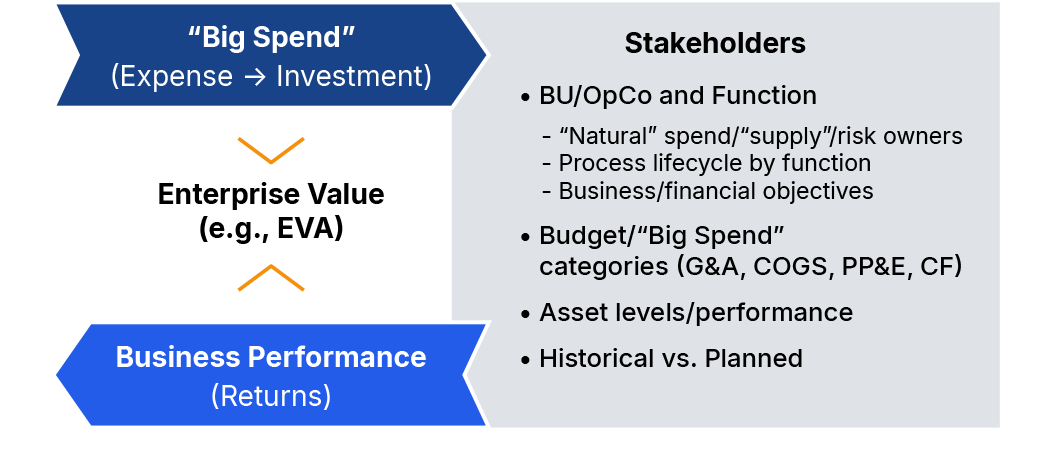
First, we need to provide the overall graphical framework, giving the backdrop on the KPIs that can be used. Basically, it starts with a simple enterprise value framework where spend/investment is made to business units (and supporting functions like procurement, finance, IT, HR, etc.) that deliver business performance, returns and enterprise value. Having a corporate value metric like EVA, ROIC or an equivalent metric that breaks down to lower-level elements can help provide a broader KPI palette to align to. Organizations that use such enterprise value metrics also tend to have more robust strategic planning and FP&A processes, which in turn help procurement organizations align.
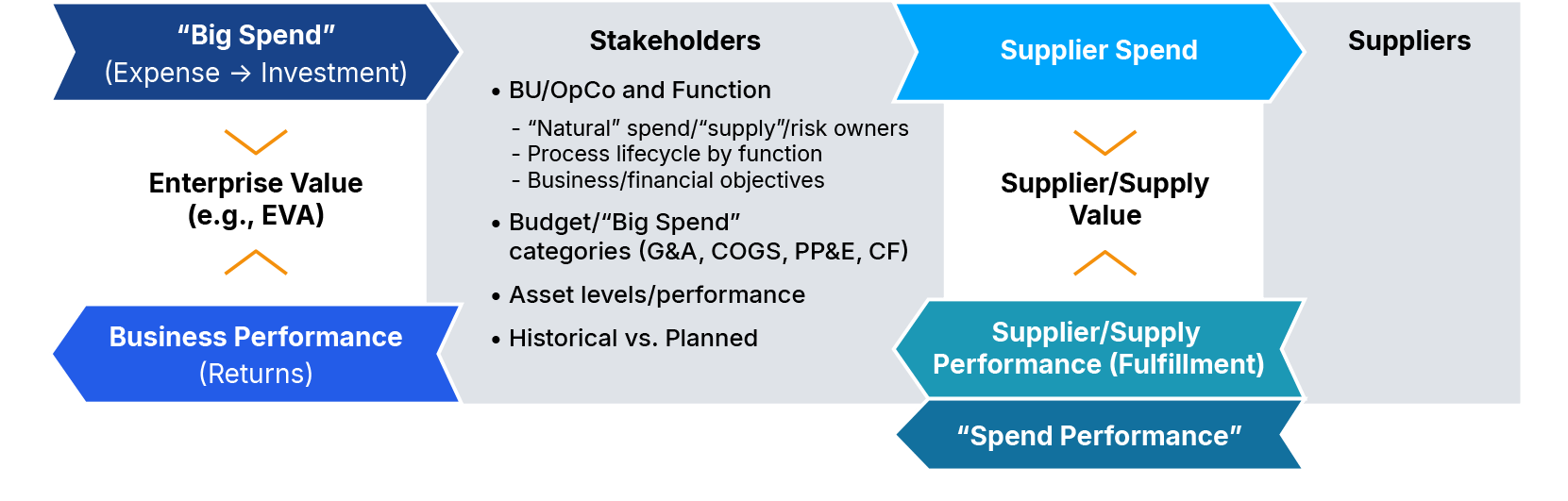
This basic framework is then extended to suppliers via supplier spending and the corresponding supply (which includes services and/or information) that fulfills the demand that generated the spend. In other words, whether enterprise spend flows to internal resources or to external suppliers, the need for economic returns remains the same.
“Spend performance” can be benchmarked via a normalized spend KPI, such as “spend as a percentage of revenue,” but supply performance is the key to maximizing supply value, which is ultimately what business stakeholders want.
You might have noticed that procurement has not appeared yet. Its addition is what completes the picture below. Procurement adds its value through having the enterprise execute a robust S2P process (and integrated to a broader supply/value chain picture) that connects this chain of value from external customers to business unit/function partners and then ultimately out to suppliers.
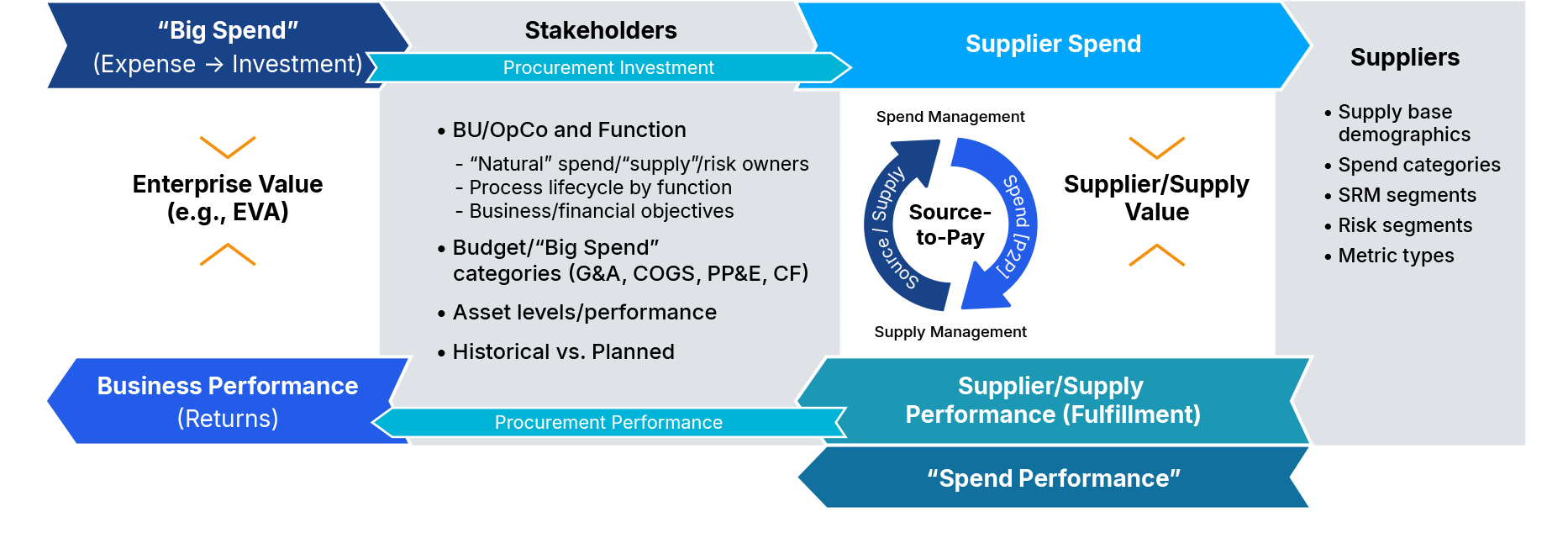
Integrated business/spend/supply management framework
The S2P process shown illustrates how “spend management” and “supply management” work together. Supply management is generally about sourcing to set up supply capabilities, and spend management is biased toward the spending process and the spend data that feeds back to sourcing.
Now we have the context to discuss the individual processes and concepts that make this all work together:
- Value management (and performance management) is the ability to repeatedly generate and improve enterprise value through competitively differentiated/defensible competencies, smart executable strategies and a performance management capability that keeps all enterprise process participants focused, aligned and supported. Extending this capability into the supply tiers while also safely tapping supplier market power are strategic procurement and strategic supplier management main concerns.
- Financial/budget management is essentially “big spend management” for all spend, whereas “small spend management” is about managing supplier spending. This is the FP&A process (and cash planning) and the Integrated Business Planning process that links out to supply chain planning.
- Demand management concerns managing the demand, which drives supply and spend. Top performing procurement/SCM organizations see and shape demand much earlier and more deeply than their peers, so they can apply all value improvement levers and create higher quality early spend influence rather than higher quantity late-stage spend influence.
- Cost management is the ability to measure and improve costs that flow to the P&L directly or indirectly. It dovetails into financial/budget management, but there can be a disconnect between procurement and finance. For example, based on our research, procurement’s top request from Finance isn’t just funding. Rather, it is leadership in strategic cost management.
- Savings management is the ability to identify cost/spend savings opportunities, coordinate resources to seize those opportunities, validate the results, pass on the savings to shareholders or budget owners and then hold the gains to reduce savings leakage.
- Service management is about managing internal business services from business functions and/or shared services groups and about extending and managing third-party services in an “XaaS world.”
- Stakeholder management concerns the management of key stakeholders in a process by the process owner (e.g., a CPO actively managing critical budget-owning business leaders and also strategic suppliers).
- Spend management deals with seeing supplier spending and the procure-to-pay processes that spend it, so that you can “spend better” tactically within P2P. It is also about spending more effectively through better sourcing, supplier management, risk management, etc. “Spend,” of course, comprises both cost drivers and demand drivers, per the aforementioned cost management and demand management.
- Supply management is about what you pay, and supply management is about what you get. It is about provisioning resources internally and externally (e.g., sourcing) to fulfill demand via suppliers, internal business partners and inventory.
- Process management (e.g., S2P management) is the ability to define, measure, analyze, improve and control a (hopefully end-to-end) business process, such as S2P, order-to-cash, etc.
- Procurement management can be defined either as 1) managing all procurement department activities/resources that only formally roll up into the procurement department, or 2) managing all procurement activities (with resource coordination via other resource owners) regardless of where the resources report.
- Category management defines and manages spend/supply segments so that strategies, processes and resources are optimized to varying degrees of granularity of the nature of that supply market (and the internal/external demands that are driving it).
- Sourcing management at its core is about gathering requirements, cost structures and market intelligence in order to formulate sourcing strategies to optimally negotiate a contract with suppliers that leads to mutually beneficial relationships.
- Supplier management (or “third-party management” more broadly proactively manages suppliers and guides supplier interactions (in the same way that “customer management” does this in the sell-side/CRM world) in terms of relationship management, performance management, quality management, risk management and information management.
- Contract management is not explicitly shown in the images above, but it is foundational to the whole value flow. Contract management is the most granular level where spend is committed by buyers and supply is committed by suppliers. These agreements are not just legal risk-transfer documents. Rather, they are ultimate B2B systems of record that capture all aspects of commercial value flow across a supply/value chain.
- Performance management is ultimately not just about execution, but about transformation. As businesses and strategies evolve, so must the KPIs. In fact, the leading performance indicators must change in order to actually lead the transformation. For example, supplier innovation metrics will need to be implemented if early supplier collaboration during product design hopes to improve new product development and downstream revenues from new products.
- Capability management deals with leading performance metrics that relate to people, processes and digital. Talent management is needed to align individuals’ performance with broader performance. Process management is needed to align the diverse stakeholders’ siloed processes. And digital capabilities are obviously needed to support and scale all of the above: KPI modeling, target setting/cascading, scorecards, value improvement tracking, etc.
There are other areas not mentioned (e.g., risk management, working capital management, project management, benchmarking, etc.), but the bottom line is that KPIs should never be developed haphazardly and in isolation. Luckily, and perhaps unluckily, the palette of KPIs to choose from is large. So, this is where picking wisely, but not being afraid to evolve the metrics, is key.
Now we turn to individual KPIs. There are many to choose from. Below is a list of 18 KPIs to choose from, which could easily include many more:
- Stakeholder-specific business KPIs (i.e., business outcomes: sales; profits; innovation; budget levels, budget attainment, etc.).
- Normalized spend performance (e.g., spend as % of revenue).
- Stakeholder-specific spend/supply/supplier metrics – linked to #1.
- Total Cost Savings (e.g., year on year; benchmarked to market) – not just supplier related.
- Supply/Value chain performance (supply continuity, cost, service/fulfillment, cash, CSR ratings) – linked to #1 and #3.
- Supplier performance (e.g., fulfillment/SLA; capability score; contract performance) – linked to #5.
- Supplier capability levels (e.g., process capability, resilience, flexibility, innovativeness) are linked to #6, as capabilities (leading metrics) enable lagged KPIs.
- Category performance (linked between the previous two and applied to multiple suppliers in the category).
- Spend under [procurement-led] management percentage. A “quality of SUM” can also be measured here or in #15.
- Procurement-led value improvements $ (per KPIs from above), including year-on-year cost savings: broken out into ‘hard cost savings’, cost avoidance / soft cost benefits, balance sheet improvements, etc.
- Procurement OpEx or Cost-of-Procurement (procurement “investment”).
- Procurement “ROI,” as calculated from the previous two.
- Stakeholder satisfaction with procurement (e.g., net promoter score, internal SLA performance, etc.).
- Supply/spend management (e.g., S2P) process metrics: cycle time, defect/rework rates, process-level productivity, etc.
- Internal S2P capability level (e.g., alignment, automation, best practice utilization, spend/contract visibility, market intelligence, risk management, etc.).
- Value leakage (maverick spend, duplicate payments, supplier penalties, etc.).
- Procurement staff performance and capabilities (skills/competencies) are tied to the above. Metrics can include 360 reviews, training, skill/competency scores, etc.
- Procurement staff engagement and satisfaction.
Procurement performance management is really a bigger story of measuring and improving spend and supply to create enterprise value as part of a multiyear transformation. It is complex and fraught with organizational land mines, but it is also critical to continually incentivize the right behaviors.
Finally, it’s an area that can benefit greatly from technology beyond just simple scorecarding tools. It includes large swaths of analytics, master data management, dynamic dashboards, process mining, robotic process automation and S2P applications that are increasingly delivering more of this technology natively within their applications. In fact, with over 600 requirements used to evaluate S2P and contingent workforce/service solutions in the SolutionMap benchmarking database, we know that providers’ solutions vary widely in their ability to implement these metrics and support the broader closed-loop spend and supply management process.
Related Insights

Beyond CLM: Why Third-Party Risk and Contract Management Must Operate as One
Contract management and supplier management are critical aspects of the source-to-pay (S2P) process, and there is significant overlap between the…

Beyond Savings: Can Your Organization Prove Procurement’s Full Business Value?
Traditional savings opportunities are becoming harder to find, yet procurement continues to create value across working capital, supply continuity, risk…

Contract Management Solutions
Contract lifecycle management (CLM) solutions are systems that automate the authoring, negotiation, execution, implementation, monitoring and renewal of B2B contracts…

Risk Management Solutions
In today’s volatile business environment, the importance of risk management in procurement and supply chain management cannot be overstated. Recent…