
Agentic AI and Procurement (Part 2): Why It’s Worth It
Agentic AI is sometimes framed as a vision of the future, but its strongest value proposition lies in what it is delivering today. Procurement leaders are not waiting for the technology to mature. They are applying it to real problems and capturing measurable value.
However, to understand the value of agentic AI, it is essential to distinguish between genuine autonomy and enhanced automation. Unlike systems that follow static workflows, agentic frameworks enable LLMs to dynamically determine which tools to use, what steps to take and how to adapt based on evolving goals and context.
To understand this shift, one should step back and consider where and how agentic AI is driving returns. What makes these returns particularly compelling is their compounding nature. Because agentic systems adapt based on feedback and learn from past executions, performance improves over time, driving progressively higher returns across multiple dimensions. Figure 1 shows the four dimensions that stand out across current deployments.
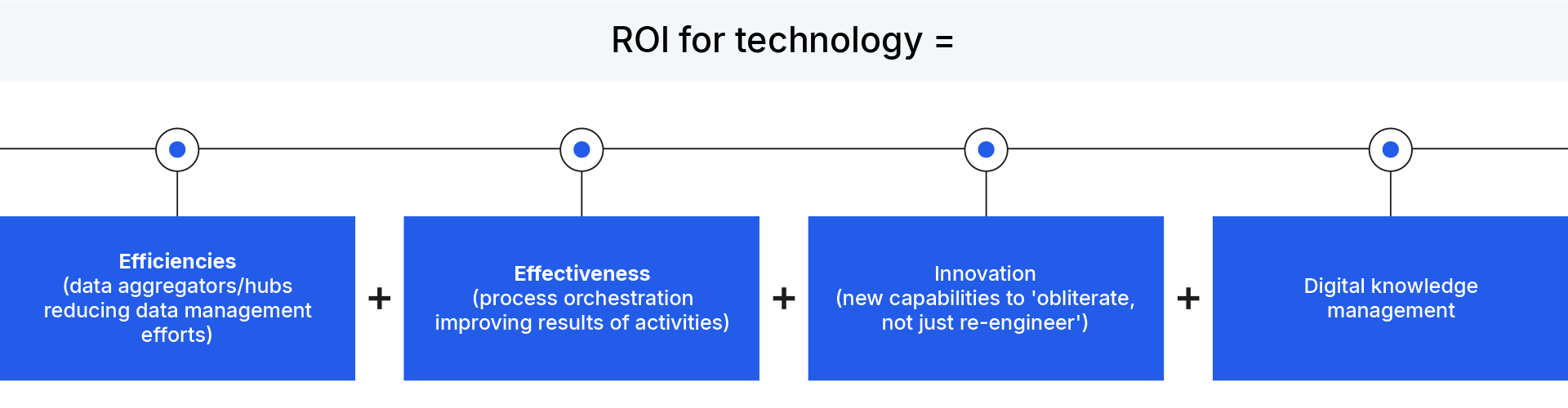
The table below outlines these dimensions and how agentic AI contributes to each:
| ROI dimension | Agentic AI contribution |
|---|---|
| Efficiencies | Reduces manual effort by automating data handling, approvals and intake-to-pay flows. |
| Effectiveness | Improves process outcomes through more consistent, accurate execution. |
| Innovation | Enables new workflows, such as autonomous sourcing and proactive risk mitigation. |
| Digital knowledge management | Builds institutional memory and insights through agent learning and adaptation. |
Efficiencies
Efficiency that leads to cost reduction remains one of the clearest, most immediate benefits of agentic AI. These improvements do not only come from removing manual steps. They result from the agent’s ability to orchestrate tasks across systems and APIs with its own reasoning. That is a key difference between legacy orchestration capabilities and today’s: automation follows instructions; agents interpret goals and decide how to achieve them.
Effectiveness
Agentic AI improves more than just speed; it transforms process reliability.
Innovation
Agentic AI does not stop at streamlining and speeding up old workflows and processes. It opens the door to entirely new ones. Not all implementations will begin at the high end of the autonomy spectrum, though. Agentic capabilities can scale gradually from semi-automated interventions to fully autonomous execution. What matters most is designing systems to evolve with learning, context awareness and increasingly complex reasoning.
Digital knowledge management
The most underappreciated benefit is how agents learn over time. As they handle sourcing, risk and compliance scenarios, they build organizational knowledge that remains intact when someone changes roles or leaves the company. Instead of relying on tribal knowledge or rigid rules, procurement can draw on systems that improve through experience.
| Dimension | Organizational knowledge | Tribal knowledge |
|---|---|---|
| Definition | Documented and structured knowledge the entire organization can access | Informal, unwritten know-how held by individuals or small groups |
| Format | Manuals, playbooks, databases, training modules, agents | Conversations, habits, personal notes, experience-based shortcuts |
| Access | Openly available across teams or functions | Known only by a few people; often hard to find or uncover |
| Governance | Managed, updated and audited by designated roles or processes | Uncontrolled; evolves organically without oversight |
| Scalability | Easy to scale and apply consistently across teams or locations | Difficult to scale; may not transfer well to others |
| Resilience | Survives staff turnover and supports long-term continuity | At risk of disappearing when key people leave |
| Use in decision-making | Provides a shared reference point for consistent, data-driven decisions | Based on memory or instinct; decisions vary between individuals |
| Impact on risk | Reduces risk through consistency and transparency | Increases risk due to gaps, inconsistencies and dependence on people |
| Change readiness | Supports change by providing a baseline for improvement | Hinders change; tacit knowledge is hard to capture and standardize |
| Example (Procurement) | A documented supplier onboarding checklist in the P2P system | A senior buyer’s unwritten tips on which suppliers are easiest to work with |
A strategic investment
Adoption of Gen AI and agentic AI is accelerating. According to The Hackett Group®, 64% of procurement leaders believe these technologies will fundamentally reshape workflows by 2030, and nearly half ran pilots in 2024. The Hackett Group® also adds that 42% of procurement teams plan to invest in new Gen AI technologies in 2025 and that 33% intend to upgrade existing tools.
Organizations are choosing to invest in agents because of these value drivers and of procurement’s ever-increasing workload. In the same report, The Hackett Group® projects a 10% increase in procurement workload in 2025 but just 1% in budget growth. This represents a 9% efficiency gap that Gen AI and agentic systems are expected to help close.
These trends also impact:
- Talent: As agents take on repetitive work, procurement professionals are leaning or will lean further into strategy, policy and governance, further moving the function away from control and compliance toward orchestration and insight.
- Technology landscapes: Architecturally speaking, agentic AI requires more than just plugging AI into existing tools. Procurement platforms must evolve to support persistent context, dynamic tool invocation and flexible error handling. Choosing frameworks that expose this control (instead of hardwired/static workflows) is key to scaling safely and effectively.
While these numbers may sound attractive, it must be noted that agentic AI does not guarantee maturity or readiness. These systems do not come with a magic wand. Their success depends on data consistency, process discipline, change readiness and clear governance. Many organizations will find their current infrastructure unready to support persistent state, dynamic tool invocation or autonomous escalation. Without the right foundations, even the most advanced agents will fall short of expectations.
Related Insights

Beyond Savings: Can Your Organization Prove Procurement’s Full Business Value?
Traditional savings opportunities are becoming harder to find, yet procurement continues to create value across working capital, supply continuity, risk…

Contract Management Solutions
Contract lifecycle management (CLM) solutions are systems that automate the authoring, negotiation, execution, implementation, monitoring and renewal of B2B contracts…

Risk Management Solutions
In today’s volatile business environment, the importance of risk management in procurement and supply chain management cannot be overstated. Recent…

Sourcing Solutions
E-Sourcing emerged as a term in the 1990s as Freemarket and others developed technical solutions to enable organizations to negotiate…