
Agentic AI and Procurement (Part 6): What’s Next on the Agentic Frontier?
Procurement has continuously evolved in waves, with formalization, digitization and, more recently, autogmentation. The next wave has already arrived. Agentic AI does not just enhance decision-making. It executes. That distinction is redefining what procurement is and how it operates.
To close our mini-series on agentic AI, we want to focus on a few, mostly forward-looking considerations for managing this newest evolution of procurement technology.
From copilots to multi-agent systems
So far, the use of most advanced AI, and Gen AI in particular, in procurement has revolved around assistants/copilots: systems that can summarize, suggest or assist.
But things are moving beyond just assistance. Agentic AI introduces autonomous agents that can act, collaborate and deliver outcomes by communicating through structured message passing and shared memory. They coordinate plans, divide responsibilities and update each other as goals evolve to allow the system to function more like a team than a tool.
Instead of a single assistant handling all queries, we are seeing multi-agent ecosystems take shape. Each agent handles a specific domain, such as negotiation, while sharing memory and coordinating actions. As more organizations adopt composable tech stacks, agents will serve as the connective/orchestration layer between systems, workflows and data. In short, it isn’t automation. It’s orchestration.
A new infrastructure layer
To support this transition, technology stacks are evolving. Open-source orchestration frameworks like AutoGen, LangGraph and CrewAI are emerging as the backbone that allows agents to plan, act and learn together. They handle logic, memory and goal setting across multiple agents. These agents sequence decisions, manage uncertainty and act independently or in coordination. These frameworks treat agents not as subroutines but as autonomous entities capable of real-time reasoning and iterative planning, with persistent context and feedback.
At the same time, enterprise applications are being or will need to be redesigned to support ‘agent-aware’ behavior:
- APIs will need to accept and respond to intent-based queries.
- ERP and procurement solutions will need to support native agent integration so software can act on behalf of users in real time.
- These changes are architectural because systems will no longer be built solely for users but for autonomous systems acting on their behalf.
From tasks to outcomes
Perhaps the most transformative feature of agentic AI is its outcome orientation. Traditional tools focus on activities like filling out forms, triggering events and sending alerts. Agents, in contrast, work toward business goals. This changes how procurement is delivered. It opens the door to AI-led services with systems that do not just support a function but perform it. What used to be an internal process becomes a capability that spans business units or even enterprise boundaries (see Figure 1).
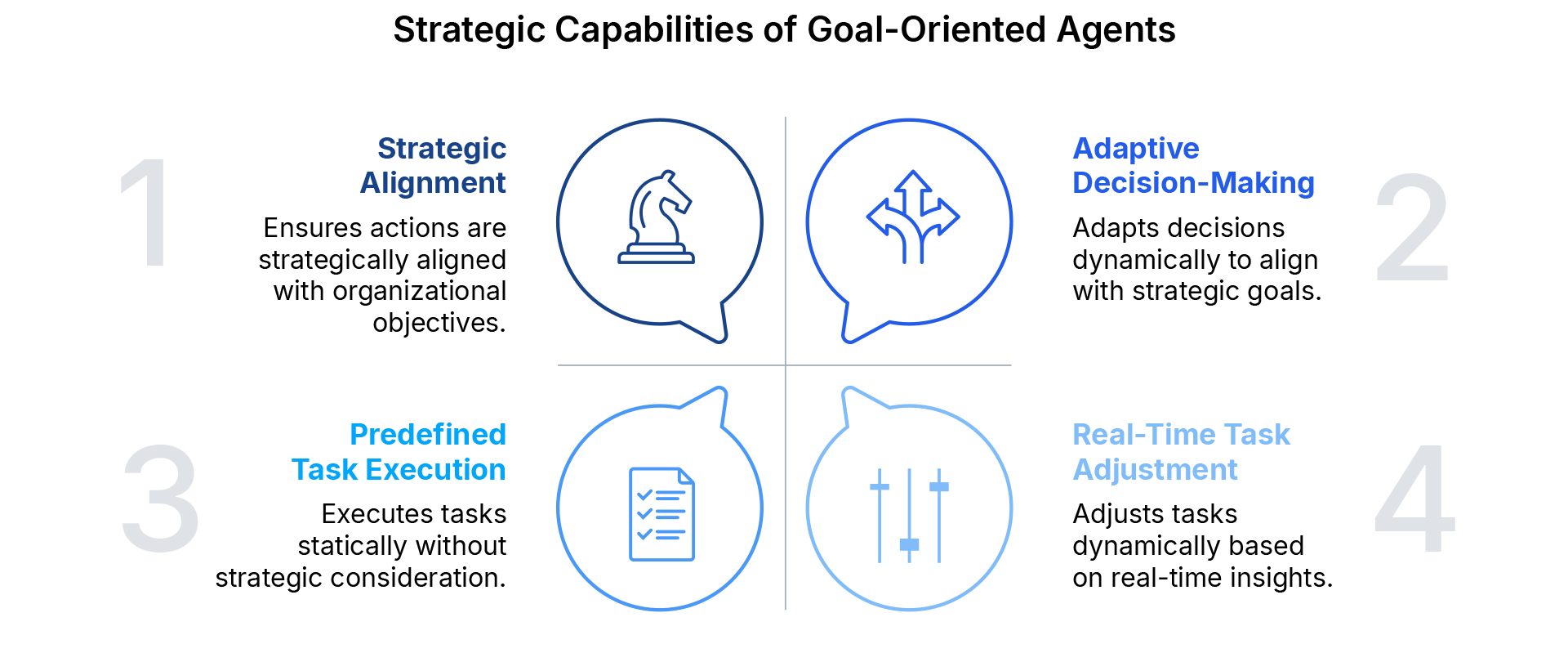
This requires rethinking how requests are framed and handled. Instead of triggering fixed workflows, agentic systems deconstruct goals into sub-tasks, select the tools to use at each step and adapt plans based on intermediate results.
Governance and accountability
As autonomy increases, so does the need for transparency. Agentic systems do not just act; they decide. That means governance must evolve to match such a change.
Agentic governance must be designed for traceability, interpretability and coordination. Agents must log not only outputs but also decision paths. They must, for example, log actions, explain the logic behind them and defer when confidence is low. Confidence thresholds, fallback logic and manual override conditions must be defined and enforced. This ‘control’ layer is often missing, and it leads to black boxes that make opaque decisions and undermine trust.
Additionally, in multi-agent environments, oversight must extend to inter-agent behavior, encompassing how agents coordinate, resolve conflicts and prevent redundant or conflicting actions.
In short, organizations will need to treat agents like employees: trained, evaluated and governed.
The procurement model: 2026-2030
Looking ahead, procurement will become a hybrid function in which humans will define strategies, goals and policy, and agents will handle execution, learning and response (see Figure 2). ‘Super-agents’ may take ownership of full categories or supplier portfolios, balancing constraints and optimizing outcomes across dimensions like cost, risk and ESG.
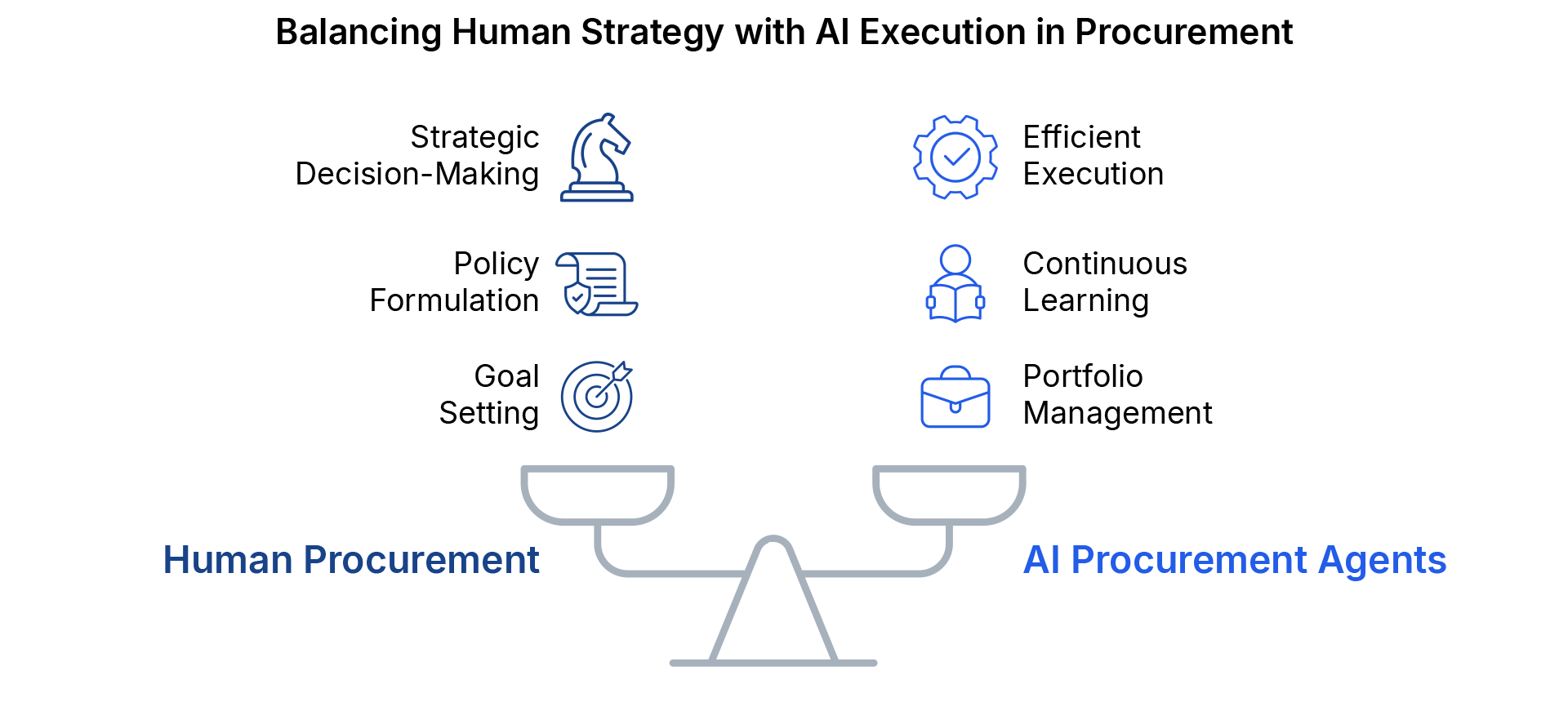
The skillset will continue to evolve. Professionals will spend more time managing systems, auditing outputs and handling exceptions. Roles will shift toward governance, design and strategic interaction, i.e., the core function will not disappear but will become supervisory and systems-driven.
The first movers will set the rules
Early adopters are already reimagining work and gaining a performance edge. In the race to operationalize Gen AI, failing to act is now the greater risk because organizations that move early will shape what ‘good’ looks like: how agents are measured, governed and scaled. They will define benchmarks, influence interoperability standards and refine operating models that others will follow.
They will also shape the standards for agent-to-agent communication, data schema interoperability and escalation protocols, laying the groundwork for an agentic ecosystem where different vendors’ agents can collaborate.
At the other end, late adopters will not just miss efficiency gains. They will find themselves constrained by legacy systems and reactive workflows when adaptability and agility are table stakes.
A final word
Agentic AI offers procurement more than automation. It provides a distinct operating model that is founded on autonomy, interaction and goal-driven pursuit. Its impact will be shaped by how leaders act now: how they structure pilots, build teams and govern execution.
Related Insights

Beyond CLM: Why Third-Party Risk and Contract Management Must Operate as One
Contract management and supplier management are critical aspects of the source-to-pay (S2P) process, and there is significant overlap between the…

Beyond Savings: Can Your Organization Prove Procurement’s Full Business Value?
Traditional savings opportunities are becoming harder to find, yet procurement continues to create value across working capital, supply continuity, risk…

Contract Management Solutions
Contract lifecycle management (CLM) solutions are systems that automate the authoring, negotiation, execution, implementation, monitoring and renewal of B2B contracts…

Risk Management Solutions
In today’s volatile business environment, the importance of risk management in procurement and supply chain management cannot be overstated. Recent…