
What You Need to Know Now About Agentic AI
The latest development in artificial intelligence (AI) is about to transform your business.
From the contact center to the board room, AI agents and intelligent virtual agents are becoming a big part of the life of every company. Not simply a smarter search engine or better word processing software, agentic AI systems are poised to transform how a lot of knowledge work is done.
Bill Gates has described agentic AI as one of the biggest changes in computing since we moved from typing commands to clicking icons. It’s a significant shift. Agentic AI systems are designed to assess situations, plan and take the right actions to achieve goals. They combine the ability to analyze information, generate insights and execute tasks, working much like skilled employees who can think, decide and act to drive results.
A world of possibilities
Consider the work already being done by the intelligent agents that were recognized by The Hackett Group® as early as our 2024 annual Digital Awards:
- Intermountain Health’s improved talent acquisition process reduced position time-to-fill from 65 to 35 days, eliminated their dependency on outside recruiters and realized cost savings benefits of over 2,000%.
- Micron Technology, Inc., projects that its intelligent virtual agent Front Door solution will allow Micron employees to spend approximately 40% less time on procure-to-pay inquiries and approximately 20% less time waiting on purchase orders, and they benefit from approximately a 15% time improvement in invoice reconciliation. Micron’s procurement team estimates that employees have saved thousands of hours by using the Front Door solution and that the company realized a 40% return on investment in the agent’s first year of service.
As these examples suggest, the agentic AI transformation will be an enormous opportunity for most companies. It goes without saying that it will also be an enormous challenge.
For corporate strategists, making the most of agentic AI systems and building a roadmap for AI agent development will require a two-step process: first, to understand what it is and why it’s likely to be transformative, and second, to reimagine how work will be done in your company now that you will soon have a whole new way of getting things done.
Across the agentic spectrum
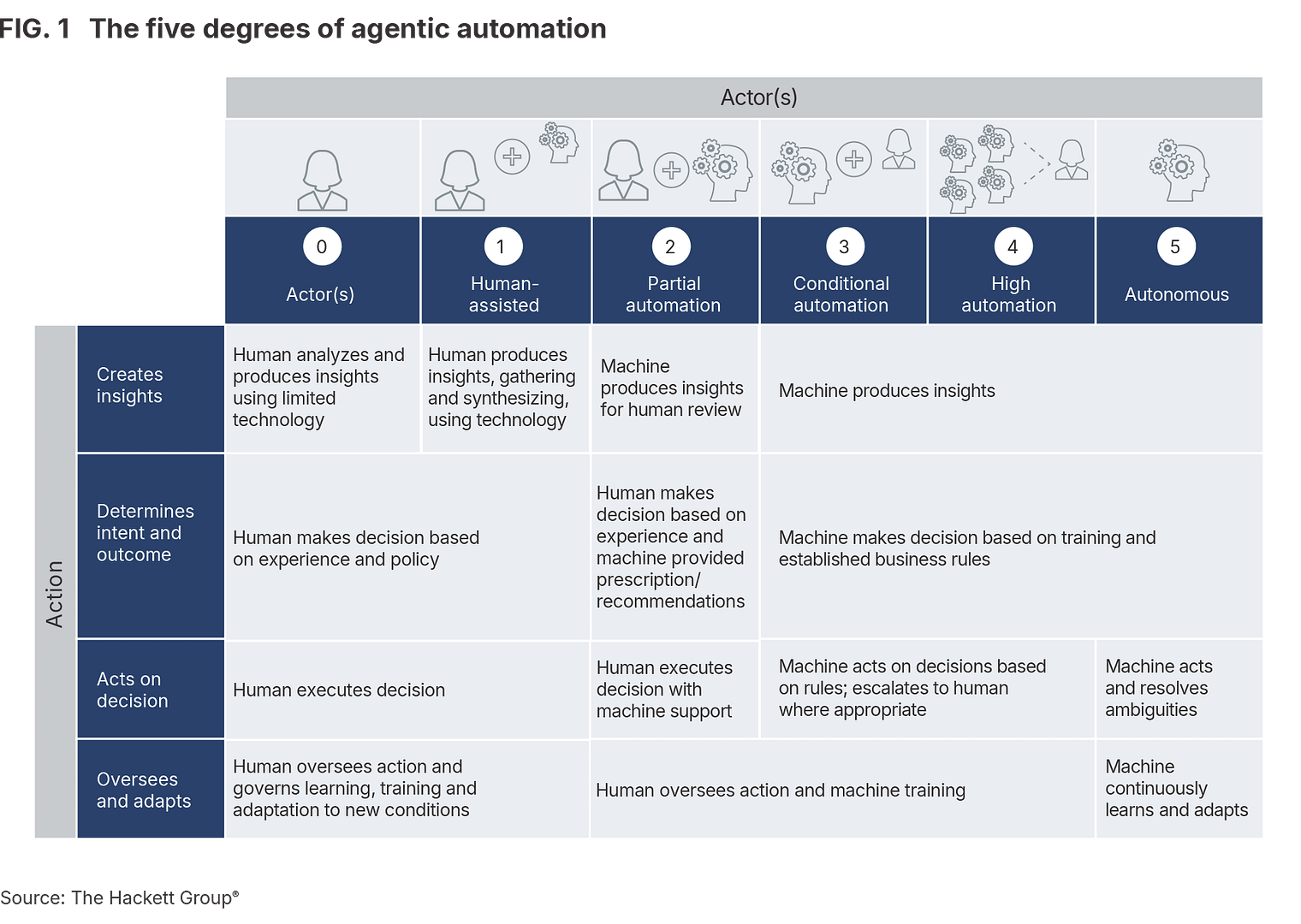
One way to conceptualize how we see agentic AI evolving is to picture a spectrum with degrees of increasing capacity (Fig. 1).
At the farthest left – the point at which most organizations operate today – humans still lead every action needed to create insights, act and reflect on the impact of that action.
One degree to the right, some structured tasks are automated. Here, digital assistants and AI agents are able to summarize meetings, translate documents and point out anomalies in datasets, freeing humans to work on higher-value projects.
Next, degree two, the intelligent agents in AI begin to recommend actions. In recruitment, this may mean reviewing resumes and background interviews, then suggesting which candidates to advance to a second round of interviews. In payments, the agent might be put to work scanning collection data to flag customers who are falling behind. Beginning on this rung, and extending through three and four, the AI agents are monitored by humans, who oversee their actions and training.
At degrees three and four, AI virtual agents take over tasks, such as supplier management or employee onboarding, previously performed by people. At this level, the machine can produce insights, make decisions based on training and established business rules, and either act in accordance with the rules or ask a human for guidance, if necessary.
Finally, at degree five, autonomous agents will be able to operate autonomously, handling such mission-critical tasks as analyzing search trends, automatically updating website content to improve search engine optimization, or monitoring for specific cybersecurity threats and patching vulnerabilities. It can resolve ambiguities on its own and continually learn and adapt, almost like any other experienced, trusted employee.
Ultimately, you will want to take much of your work to the highest degree, but you can’t do that for every process immediately. It’s too complex – and the payoffs for agentic automation also vary depending on the task in question.
Deciding where to begin is likely to be a challenge. Should you use workflow agents that can help you automate tasks? Cognitive agents that can help accelerate complex problem solving? Conversational agents that engage users in conversations? Content agents – including LLM agents – that can generate text, images, audio and code based on patterns learned from existing data? Or maybe you want to start with insight agents trained to analyze data to uncover trends, which can be assisted by prediction agents able to look at historical data to forecast your future?
Developing the right mix of AI agent development strategies and governance frameworks will be key to moving your organization across the agentic AI systems maturity curve.
Getting started
Given that the range of available AI agents on the market is wide and growing wider every day, the easiest way to proceed is to consider your needs first, rather than the technology.
One good way to start is through ideation – a focused approach to brainstorming process improvements used by many of the winners of the Hackett Innovation Awards. We recommend breaking this exercise into three stages:
- Ask process owners and contributors how particular tasks are performed now. Most knowledge work is poorly documented and poorly understood. Even moderately complex tasks rely on the tacit knowledge of individual contributors.
- Encourage the employees who are doing this work now in a traditional way to participate in discussions about how and where AI virtual agents or intelligent agents in AI might help them. Rather than trying to design a process that is 100% automated, it’s often more productive to focus on identifying particular steps of more complex tasks where AI agents could play a role.
- Imagine how and where the next generations of digital assistants or AI assistants might be able to further enhance a process – or even eliminate it altogether – and where you want to invest the time and energy this automation will gain your organization.
If you’re unsure where to begin, partnering with an AI consulting expert or exploring AI agent development pathways can help accelerate your automation journey with confidence.
On the Verge
After that, get ready to repeat the whole exercise again next year because this is only the beginning of the agentic AI revolution. We are starting to live in a world in which specialist Agentic RAG – enabled systems streamline specific processes and free human workers to focus on more strategic tasks. And even there, human workers will have help: AI agents designed to take a more strategic view will act as trusted advisors able to add additional context at a board meeting or inform directors of emerging risks and opportunities. Some may even function as autonomous agents, continuously monitoring and responding to changing business conditions. In the end, advanced AI agent development will result in tools that are more than just utilities. They are currently and will continue to be partners.
It’s time to act. Contact us to learn how our AI consulting services can support your goals – or to schedule a demonstration.
Related Insights

Unlock the Future: Reimagine Work with Agentic AI
The future of work is here—agentic AI is driving up to 40% gains in productivity and decision-making. Ready to transform…

Revolutionize AI Execution With ZBrain™
Technology leaders are accelerating generative artificial intelligence (Gen AI) success by turning strategy into scalable execution. ZBrain™ is The Hackett…

Smarter. Bolder. Gen AI-Driven Transformation.
In a time of constant disruption, enterprises with Digital World Class® IT organizations are achieving outsized gains – 40% more…

Unlocking AI: Importance of Proof of Concept
On this episode of the “Gen AI Breakthrough” podcast, Kyle McNabb hosts a discussion on the importance of proof of…