
Achieving Digital World Class® Procurement Excellence Through Gen AI
In today’s volatile, uncertain, complex, and ambiguous (VUCA) business climate, procurement leaders must operate with more agility, insight, and strategic foresight than ever before. The first half of 2025 saw organizations adopt increasingly cautious stances toward investments, shifting focus to risk mitigation. Amid this disruption, some procurement functions are not only staying afloat – they’re pulling ahead.
These high-performing teams – defined by The Hackett Group® as Digital World Class® – are reimagining their procurement strategy to deliver greater value, operational excellence and agility. They are delivering 2.6 times greater return on investment (ROI) through a lean, highly productive and intelligent operating model, with 31% fewer full-time equivalent (FTE) staff and 19% lower functional cost as a percentage of spend. With intelligent automation and a data-driven approach at the core, they are setting new standards in strategic sourcing and service delivery. At the heart of this transformation lies a redesigned operating model – powered by generative artificial intelligence (Gen AI), advanced analytics and continuous process improvement.
The strategic shift: From cost center to AI-powered partner
Procurement is undergoing a paradigm shift. In the face of economic uncertainty, businesses are demanding greater value from procurement – not just in terms of cost savings, but in risk management, innovation, and alignment with corporate goals. This has elevated the function from a tactical executor to a critical enabler of business strategy.
To thrive, procurement leaders must rethink their operating model, and embrace tools and practices that enhance agility, transparency, and stakeholder experience. This includes:
- Aligning the procurement strategy tightly with business objectives
- Leveraging AI-enabled tools for faster, smarter decisions
- Reengineering business processes to adapt to shifting market dynamics
- Developing intelligent automation workflows for repeatable, high-volume tasks
- Building robust scenario modeling and risk analysis capabilities
As businesses increasingly recognize the potential of Gen AI and foundational large language models, the opportunity to drive transformational change has never been greater.
Digital World Class® procurement: A model for success
The Hackett Group’s research identifies four defining characteristics of Digital World Class® procurement teams.
1. Increased emphasis on value-add analytics and relationship/stakeholder management
With the increased focus on value-add analytics and relationship/stakeholder management, Digital World Class® procurement teams are becoming more strategic. Their head counts are rising to support expanded responsibilities, resulting in stronger performance across value delivery, cost savings and business engagement. This shift, which began in 2022 and is set to continue in 2025, has led to a rise in cost-to-serve as organizations invest in capabilities aligned with their broader, more modern roles. Both Digital World Class® and peer organizations are experiencing increases in labor and technology expenses.
Digital World Class® procurement functions dedicate a significantly higher share of their workforce to strategic tasks – 26% more than peer organizations. These tasks include spend analysis, supplier relationship management and stakeholder collaboration.
This higher level of strategic alignment makes a difference. Teams with medium-to-high alignment of procurement performance goals with company strategy deliver a 3.1 times higher ROI. Furthermore, top-performing procurement leaders are accelerating their processes to meet increasing demands. They’ve achieved a 24% reduction in sourcing time for contracts that aren’t automatically or informally renewed, and a 58% cut in the requisition-to-purchase order cycle time for nonbid items.
Teams with medium-to-high alignment of procurement performance goals with company strategy demonstrate a 3.1 times higher ROI.
2. Superior value delivery recognized across the enterprise
ROI for Digital World Class® procurement teams is 2.6 times higher than that of peers – driven by greater cost savings, higher stakeholder satisfaction and tighter alignment with enterprise goals. These teams regularly deliver 6%-8% savings as a percentage of spend, outperforming the 3%-4% range of average organizations.
Moreover, internal stakeholders are twice as likely to rate these teams as having exceeded expectations. This isn’t just about hard metrics – it’s about building a procurement strategy that partners with the business to unlock value. With improved contract compliance and reduced maverick spend, procurement proves its value as a trusted advisor and innovation facilitator.
3. Continuous talent management and development
Modern procurement requires a new set of competencies. Digital World Class® organizations prioritize talent management as a strategic imperative. They provide 2.1 times more training hours per colleague, and develop structured retention plans to maintain institutional knowledge and leadership continuity.
Critically, these teams invest not just in technical procurement knowledge, but in soft skills, digital literacy and agile ways of working. Strategic thinking, AI fluency, and cross-functional collaboration are emphasized, creating a workforce that is adaptable, future-ready, and capable of leading digital transformation across the enterprise.
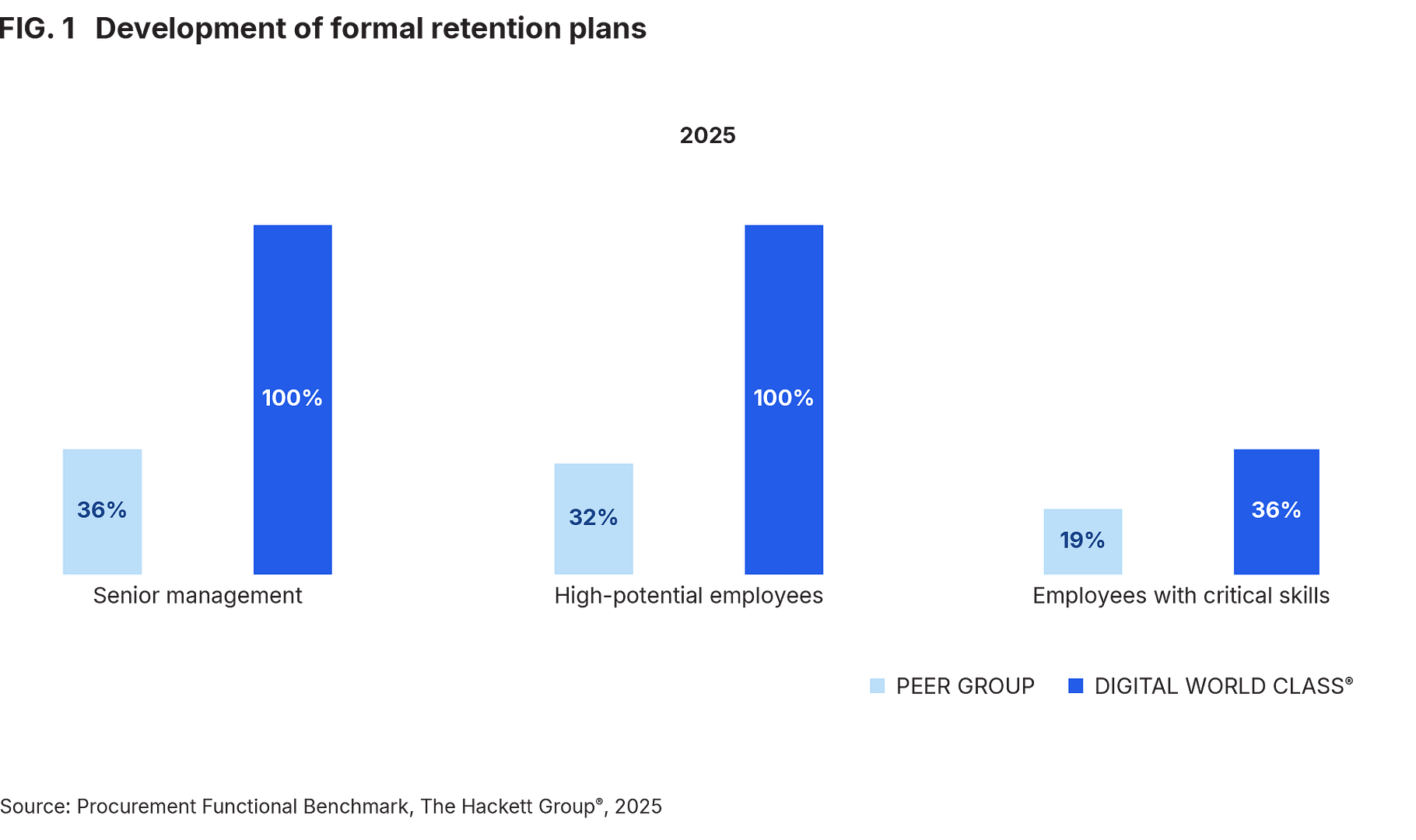
All Digital World Class® procurement organizations have formal retention plans for senior management and high-potential employees – far exceeding their peers (Fig. 1).
This contributes to higher organizational tenure – 25% for procurement managers and 71% for other procurement positions – which is critical for maintaining a high degree of institutional insight.
4. Digital maturity and insight-led operations
Technology is a defining element of operational excellence. Digital World Class® teams invest 1.8 times more of their budget (16%) in technology. Their cost of procurement technology as a percentage of spend is 33% higher, and their cost of procurement technology per FTE is 94% higher. Many areas of their operation are impacted by this digital transformation: engagement, workforce and organization, and the digital ecosystem. This transformation is enabling many teams in 2025 to move beyond AI and Gen AI discovery to the wide-scale adoption of concrete AI-enabled solutions.
Building the future: A blueprint for intelligent procurement
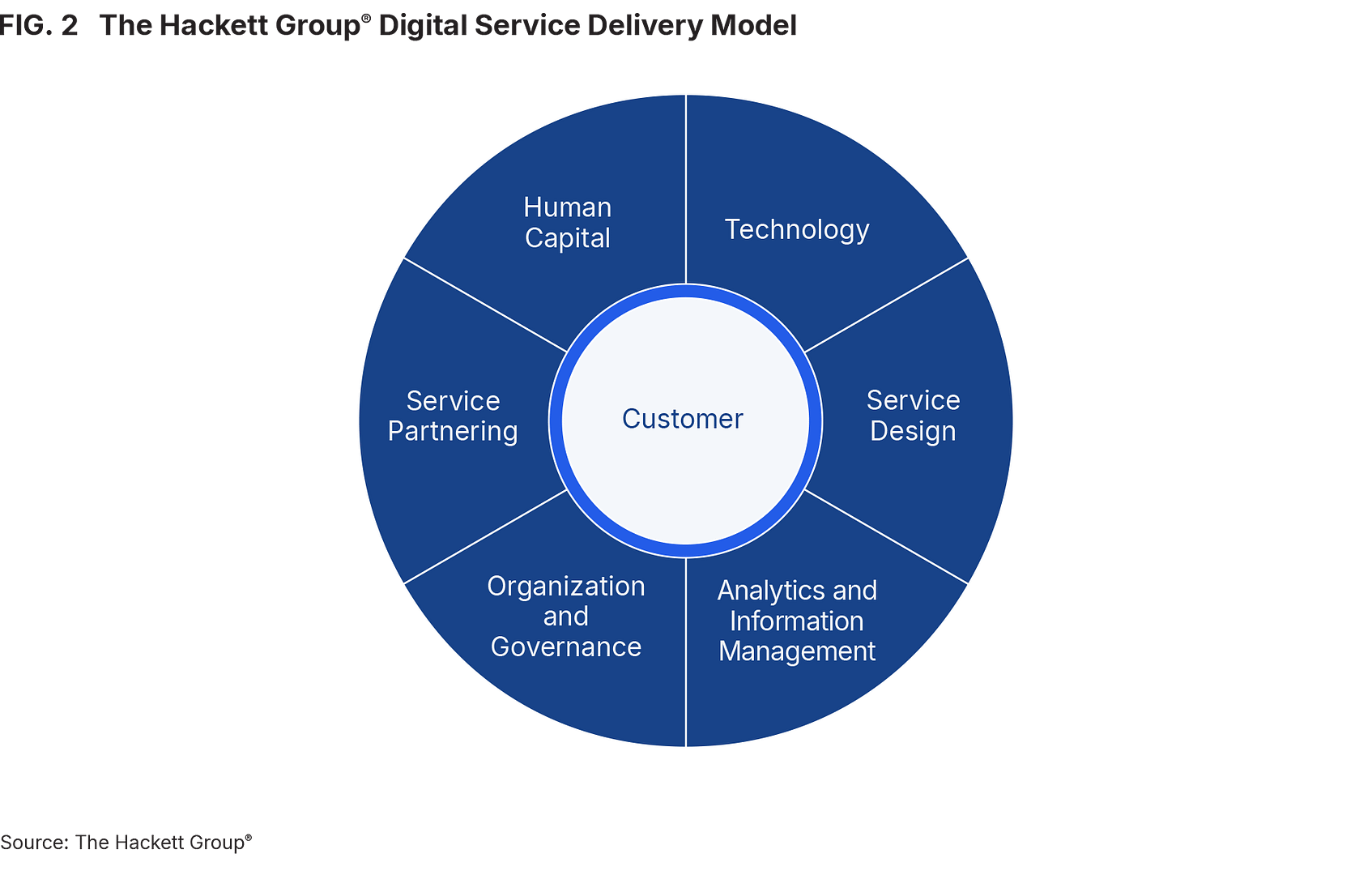
To achieve Digital World Class® performance, procurement organizations must rethink their service delivery across the six primary elements of The Hackett Group’s Digital Service Delivery Model (Fig. 2) facilitated by their adoption of emerging technologies such as digital and AI-enabled tools. We recommend consideration of the following:
1. Service Design
- Move beyond one-size-fits-all processes, supply and stakeholder relationships.
- Adopt a laser focus on stakeholder experience for both business requisitioners and key stakeholder groups.
- Redesign service delivery based on enhanced AI, Gen AI and agentic AI capabilities.
2. Service Partnering
- Engage high-capability digital, intelligence and other third-party services to empower the procurement organization for a VUCA world.
- Tap into external expertise in areas like environmental, social, and governance (ESG), supply risk, and Gen AI to accelerate transformation and build competitive advantage.
3. Technology
- Adopt an integrated, user-friendly tech stack that includes enterprise resource planning, spend suites and best-of-breed tools.
- Use intelligent automation and Gen AI capabilities for such activities as sourcing, supplier engagement, and contract management.
- Leverage Gen AI tools to transform ways of working and greatly accelerate speed of execution – for example, to create strategies and negotiation plans, identify supply risks, perform cost and market analyses, and draft language for contract terms and clauses.
4. Human Capital
- Invest in training, recognizing that many procurement colleagues did not start their careers in this discipline. Emphasize business skills over technical skills because they are more influential in delivering business impact.
- Create career paths that encourage development and retention. Enhanced or new roles may include insights and analytics, relationship management, communication and collaboration, digital technology skills, and fluency with AI technologies.
- Use workforce planning to introduce roles focused on insights, collaboration and change leadership.
5. Analytics and Information Management
- Ensure data accuracy and integrity through AI-powered enrichment.
- Build an information architecture that facilitates access to real-time insights.
- Define insight requirements for answering key business questions, the internal and external data, and information sources necessary to address those questions, and the supporting self-service reporting, analytics, AI, and information management technology to enable delivery.
6. Organization and Governance
- Separate strategic from operational tasks and focus spend management teams on the former.
- Stay lean by leveraging the additional capacity and advanced expertise of enterprise corporate capability centers in areas such as talent, digital, AI, or sustainability.
- Centralize administrative functions and create centers of excellence core capabilities like intelligence, supply innovation, and ESG.
- Embrace agile methods and cross-functional teaming to drive speed and responsiveness.
In conclusion, closing the performance gap isn’t just about technology. It’s about reimagining how procurement operates, who it hires, how it measures success and how it partners with the business. With the right strategy, capabilities, and a strong AI strategy and mindset, procurement can become one of the most dynamic and impactful functions in the modern enterprise.
You can learn more here.
Related Insights

Lead at Gen AI Speed: 2.6X ROI, 58% Faster Procurement
Disruption is constant – so is the opportunity to outperform. Digital World Class® procurement teams are doing just that, delivering…

Transform Procurement Performance With Intelligence and Gen AI
On this episode of the “Gen AI Breakthrough” podcast, Chris Sawchuk and Nic Walden discuss the concept of digital world-class…

Define Your Next-Generation Operating Model – Enabled by Gen AI
Our complimentary research report shares insight on how top-performing procurement organizations are redefining their operating models.

2026 Procurement Key Issues
Procurement leaders are turning AI into a measurable impact in 2026. Discover how leading organizations are improving performance as AI…