
Close the Enterprise AI Performance Gap
How disciplined AI investment changes the economics of enterprise performance
Executive summary
- A 75% performance gap is emerging between enterprises that redesign work around artificial intelligence (AI) and those that simply automate existing processes.1 The next competitive advantage will be defined by enterprise performance, not AI adoption.
- Leading organizations are using AI to reinvent enterprise operating models, not simply deploying new technology. By redesigning end-to-end processes and applying AI where it creates the greatest enterprise return, they are creating structural advantages in productivity, operating leverage, decision quality and overall business performance.
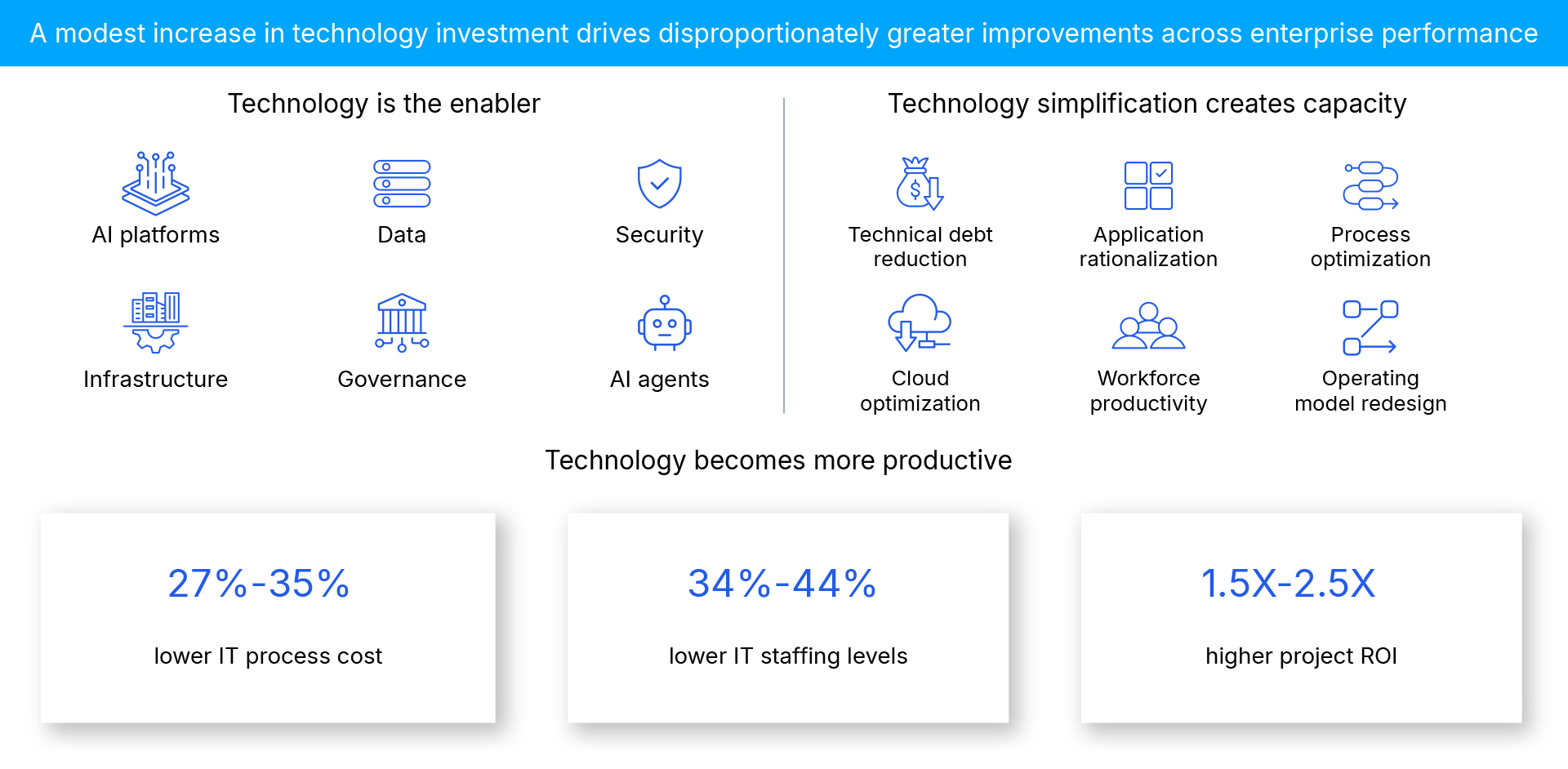
- Technology organizations illustrate the economics of disciplined AI investment. AI World Class organizations simplify the technology landscape, reduce technical debt and modernize operating models, decreasing information technology (IT) process costs by 27%-35%, lowering staffing levels by 34%-44% and improving projected return on investment (ROI) by 1.5X-2.5X.2
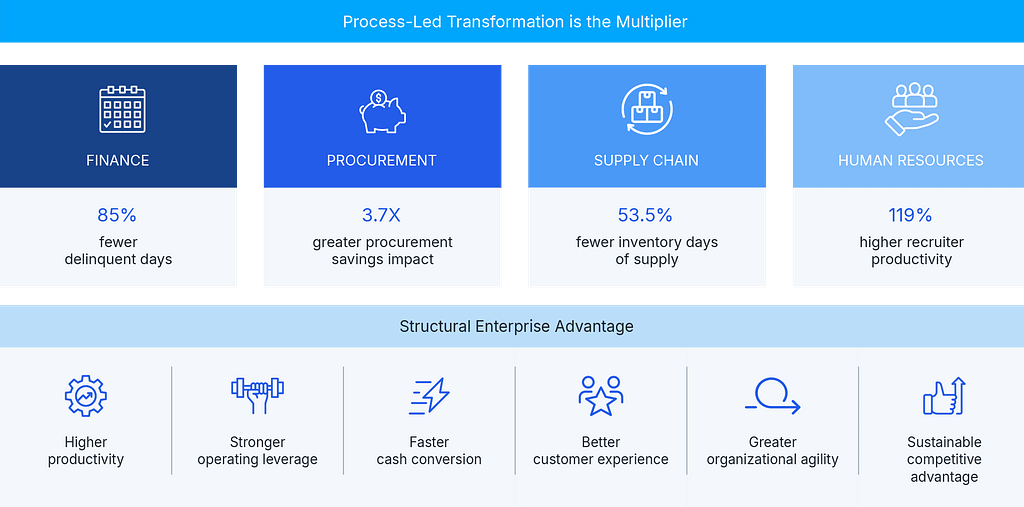
- The value compounds across the enterprise. By directing AI investment where it generates the greatest enterprise return, technology leaders enable significant improvements across end-to-end processes – from 52%-59% lower order-to-cash process costs and up to 2.7X greater procurement ROI to 53.5% fewer inventory days of supply and 61% lower recruiting costs – creating cumulative gains in productivity, operating leverage, cash conversion and customer experience.3
- The organizations pulling ahead apply AI with discipline. Rather than pursuing isolated use cases, chatbots and productivity tools, they build a repeatable capability to identify, prioritize and scale high-return AI investments.
Bottom line: Enterprise AI adoption began with experimentation and deployment. It will increasingly be defined by enterprise performance. Organizations that apply AI with discipline, direct investment into the highest-value opportunities and reimagine work around AI will establish a lasting competitive advantage.
1, 2, 3, AI World Class benchmark modeling based on peer median and AI World Class performance scenarios, The Hackett Group®, 2026
The enterprise AI performance gap
A 75% performance gap is emerging, according to AI World Class benchmark modeling between enterprises that reimagine end-to-end processes around AI and those that simply automate existing ones.4 AI World Class benchmarks help technology leaders identify where AI investment will have the greatest impact.
For decades, organizations competed through products, markets and scale. Increasingly, they will compete through operating performance driven by faster and better decisions. Leading organizations are redesigning how work gets done across the enterprise, using AI as a key enabler to improve decision quality and speed, accelerate execution, strengthen customer relationships, and enable new products and services. As a result, the economics of enterprise performance completely change through higher productivity, greater scalability and more efficient operating models.
As AI investment accelerates, many organizations continue to measure success by AI adoption rather than business outcomes. Yet AI adoption alone is proving to be a poor predictor of enterprise performance. Organizations that prioritize AI deployment before determining where it can deliver the greatest return often automate isolated activities, increasing technology complexity while delivering only incremental business improvement.
The organizations creating breakthrough value take a different approach. They begin with the business outcome, reimagine end-to-end processes and operating models around that objective, and apply AI where it changes how work is performed.
This places chief information officers (CIOs) and enterprise AI leaders at the center of enterprise transformation. Their role extends beyond accelerating AI adoption or modernizing technology. Working with business leaders, they help determine where AI can create the greatest value and ensure AI-powered transformation scales securely and consistently.
4 AI World Class benchmark modeling based on peer median and AI World Class performance scenarios, The Hackett Group®, 2026
How AI value compounds across the enterprise
AI presents a paradox for technology leaders. It demands greater technology investment – even as executives expect lower operating costs, higher productivity and stronger business performance. For CIOs and enterprise AI leaders, the challenge is no longer simply funding AI. The challenge is directing AI investment where it generates the greatest enterprise returns.
AI World Class organizations fund that investment by reducing technical debt, rationalizing applications and modernizing operating models – redirecting technology spending from maintaining complexity to higher-return AI investments. For many organizations, maintaining legacy technology and process complexity already consumes approximately 40% of IT budgets. By reducing that burden, technology leaders create capacity to accelerate AI investment without proportionately increasing overall technology costs. That same discipline also improves the economics of the technology function, reducing IT process costs by 27%-35%, lowering IT staffing levels by 34%-44% and improving project ROI by 1.5X-2.5X.5
The greatest returns, however, extend beyond the technology function. The investment becomes the catalyst for process-led transformation across the enterprise. Finance organizations redesign order-to-cash processes to reduce costs by 52%-59% while accelerating cash conversion.6 Procurement organizations generate up to 2.7X greater ROI and significantly greater sourcing impact.7 HR organizations reduce recruiting costs by 61% while increasing recruiter productivity by 119%.8 As these improvements reinforce one another across multiple business functions, the enterprise return on AI investment extends far beyond the direct savings realized within IT.
The measure of success is no longer how much AI has been deployed. It is how effectively AI investment improves enterprise performance. AI World Class organizations do not deploy AI everywhere. They simplify technology, redesign work and direct AI investment to the opportunities that generate the strongest returns.
5, 6, 7, 8, AI World Class benchmark modeling based on peer median and AI World Class performance scenarios, The Hackett Group®, 2026
How AI changes the economics of enterprise performance9
9 AI World Class Purchase-to-Pay benchmark modeling based on peer median and AI World Class performance scenarios, The Hackett Group®, 2026
How disciplined AI investment creates compounding enterprise val
The organizations getting the strongest returns from AI do not treat AI as a collection of independent technology initiatives. Instead, they manage AI as an enterprise investment portfolio, continuously evaluating and prioritizing investments that drive the highest business value. That discipline changes how AI investments are prioritized. Rather than approving projects one use case at a time, AI World Class organizations evaluate opportunities in the context of end-to-end business processes, enterprise operating models and measurable business outcomes. Investments are sequenced to maximize cumulative value, allowing improvements in one area of the business to reinforce gains in others and accelerate enterprise performance over time.
For CIOs and enterprise AI leaders, this requires a different operating model. High-performing technology organizations often begin by transforming their own operations, using AI to redesign areas such as the service desk, software development lifecycle and cybersecurity before helping business functions apply the same discipline across the enterprise. Partnering with business leaders, they then establish a shared technology, governance and security foundation, and measure success by business outcomes rather than adoption levels. This creates a self-reinforcing cycle. Each successful transformation strengthens the business case for the next, creates capacity for additional investment, reduces implementation risk and accelerates organizational learning. Over time, organizations build a repeatable capability to identify, validate and scale AI investments. That – not AI adoption alone – becomes the source of sustainable competitive advantage.
The discipline extends across the enterprise
As AI becomes foundational to enterprise competitiveness, the organizations creating the greatest AI value apply the same disciplined approach across every major business function – identifying the highest-return AI opportunities, validating business impact and scaling what works.
In one engagement, a software and services company mapped its quote-to-cash process end to end, identified the highest-return AI opportunities, and rapidly prototyped AI-enabled solutions. The result was a 60% faster booking cycle, demonstrating how end-to-end process redesign can accelerate business performance.
In another example, a global warehousing and logistics company managing thousands of high-value contracts redesigned its contract-to-payment process using AI. Intelligent agents extracted contract terms and entitlements, tracked milestone completion, identified unclaimed fees, monitored change orders, and validated performance fee eligibility. Payment processing accelerated by 30%-50%, while the organization identified more than $20 million in potential annual revenue recovery.
The same thinking is transforming other enterprise functions. A global packaging manufacturer introduced a procurement intelligence agent that combined purchasing, spend and market data to strengthen sourcing decisions, accelerating decision-making by up to 40% and generating projected ROI exceeding 6,000%. A large healthcare organization redesigned its talent acquisition process using AI and automation, reducing time-to-fill from 65 days to 35 days, eliminating dependence on external recruiters, and realizing cost savings of more than 2,000%.
Across these examples, the pattern is consistent: Outsized returns emerge when AI is tied to a material business opportunity and embedded within a redesigned end-to-end process.
How AI World Class quantifies opportunity
Organizations create value from AI in different ways – from targeted productivity improvements to end-to-end process transformation and enterprise operating model redesign. Success depends on determining where AI will create transformative enterprise value, what level of change is required and which investments will deliver the strongest business outcomes.
AI World Class benchmarks answer those questions by quantifying opportunities at the process, subprocess and work-step level. The benchmarks draw on more than 30 years of data, process intelligence, and transformation experience with 98% of the Dow Jones Global Titans, 97% of the Dow Jones Industrials and 90% of the Fortune 100. The analysis identifies where AI can materially improve performance, technology simplification creates capacity for transformation and investment generates the strongest return.
Unlike generic AI business cases that begin with technology or isolated use cases, AI World Class benchmarks begin with how work is actually performed. Current workflows, automation levels, operating environments and technology complexity are validated before modeling future-state performance. This provides an evidence-based view of where investments should be prioritized to maximize enterprise impact.
The result is a fact-based investment roadmap that helps business and technology leaders align AI investment with enterprise priorities, quantify expected performance improvements, and build business cases grounded in measurable outcomes rather than assumptions.
Where technology leaders start
Closing the enterprise AI performance gap requires more than deploying new technologies. It begins with business and technology leaders working together to identify where AI can create the greatest enterprise return, then reimagining how work could be performed with AI before designing the technology, governance and operating model needed to make that future state possible. Technology leaders pursuing AI World Class transformation typically begin with four steps.
- Identify the highest-value business opportunities. Evaluate enterprise priorities, end-to-end processes, application capabilities and technology constraints to determine where AI can deliver the strongest returns. The objective is not to simply solve business problems, but to identify the opportunities with the greatest potential to improve productivity, operating leverage, decision quality, customer outcomes and overall business performance.
- Reimagine how work gets done. Rather than automating existing activities, define how decisions, workflows and operating models could change if AI were embedded throughout the process, creating different economics and business outcomes.
- Build the enabling foundation. Design the technology architecture, data, governance, security and operating model needed to enable the future state. Simplify the technology landscape, reduce technical debt and leverage existing enterprise platforms wherever possible to enable AI to scale rapidly, responsibly and consistently across the enterprise.
- Deliver and scale transformation. Sequence initiatives based on enterprise return, organizational readiness and technology dependencies. Validate business impact rapidly, scale successful implementations quickly and build a repeatable capability to continuously identify, prioritize and scale the next high-return AI opportunity.
The organizations that pull ahead will be those that consistently find the next high-return opportunities, reimagine how work gets done and scale what works, turning AI-enabled transformation into a repeatable capability and a lasting source of competitive advantage.
Let’s plan your next move, together.
The first wave of enterprise AI adoption was primarily about experimentation and deployment. The next wave will be defined by performance as organizations apply AI with discipline to redesign work, improve enterprise performance and create sustainable competitive advantage.
Working alongside business leaders, technology leaders will play a central role in that transformation by identifying where AI can create the greatest value, architecting solutions that leverage existing and emerging technology capabilities, directing investment where returns are strongest, and enabling AI-powered transformation to scale across the enterprise. The question is no longer whether AI will transform enterprise performance. It is how quickly organizations can capture that advantage.
The Hackett Group® combines AI World Class benchmarks, proprietary process and performance intelligence, AI-powered platforms, and expert-led execution to help business and technology leaders identify the highest-return AI opportunities, prioritize investments, accelerate enterprise transformation and change the economics of enterprise performance.
It’s time to act. Contact us for more information or to schedule a demonstration.
Related Insights

2026 AI World Class Technology
Closing the Enterprise AI Performance Gap
A 75% performance gap is emerging between organizations that redesign work around artificial intelligence (AI) and those that simply automate…

Beyond CLM: Why Third-Party Risk and Contract Management Must Operate as One
Contract management and supplier management are critical aspects of the source-to-pay (S2P) process, and there is significant overlap between the…

AP Automation/Invoice-to-Pay Solutions
Accounts Payable (AP) /Invoice-to-Pay (I2P) automation software is designed to streamline AP processes within organizations by automating the receipt, processing…

Carbon Management Solutions
Carbon management solutions are designed to assist companies in reducing their carbon footprint, usually taking into consideration the emissions of…