
Human Resources Benchmarking
Benchmark HR Performance and Quantify AI Opportunity
Artificial intelligence (AI) is redefining how organizations attract, develop, support and retain talent. Human resources (HR) leaders need to know where AI can create the greatest business value and which investments will deliver the greatest impact on workforce performance, organizational capability, and business performance. The Hackett Group® combines AI World Class benchmarks, decades of HR performance intelligence, validated HR metrics and AI-enabled platforms to help HR leaders identify performance gaps, quantify AI opportunities, and build defensible business cases for transformation.
The HR performance gap is growing
A new performance divide is emerging between organizations that redesign HR processes around AI and those that simply automate existing ways of working. HR leaders face growing pressure to do more with less – improving workforce productivity, organizational capability and employee experience, while operating with constrained budgets and resources. The challenge is no longer whether to invest in AI. The challenge is knowing where AI can create the greatest business value and which investments will deliver measurable returns.
Decision-grade benchmarks for high-stakes decisions
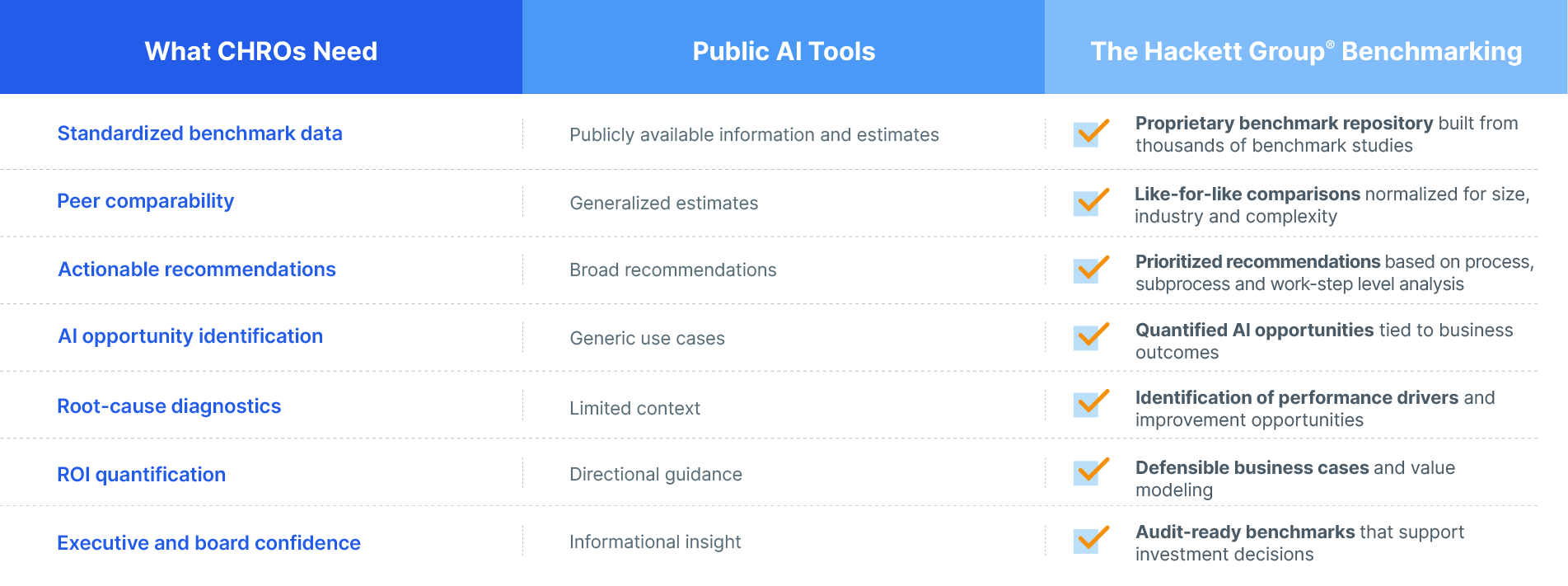
As AI transforms the workforce, HR leaders need to distinguish between informational guidance and decision-grade HR benchmarking. Strategic workforce and AI investment decisions require validated data, peer comparability, and measurable business outcomes.
Benchmark against today’s leaders and tomorrow’s possibilities
Digital World Class® benchmarks measure how leading HR organizations perform today. AI World Class benchmarks quantify the future-state performance achievable when HR processes and operating models are redesigned around AI.
AI transformation starts with process, not technology
The highest-performing organizations do not begin with AI tools. They begin by identifying where process redesign can create the greatest business value. AI World Class organizations prioritize investments using a disciplined framework that balances business impact, implementation complexity and expected ROI.
Business impact
Focus on the HR processes with the greatest potential to improve workforce productivity, organizational capability and business performance.
Implementation complexity
Evaluate organizational readiness, technology requirements, supplier data maturity and execution effort before investing.
Expected ROI
Prioritize opportunities based on measurable improvements in productivity, HR costs, employee experience and business outcomes.
Time-to-value
Sequence initiatives to deliver measurable workforce improvements quickly while building momentum for broader HR transformation.
Quantify your HR performance gap
HR benchmarking provides an objective view of where performance gaps exist today by combining benchmark data with validated HR metrics, revealing where AI can create the greatest value and what future-state performance is achievable across the HR function.
Hire-to-retire: An AI World Class example
Process reinvention unlocks the full value of AI. The greatest performance gains occur when AI is applied across the entire hire-to-retire lifecycle rather than through isolated automation initiatives. AI World Class organizations improve workforce capability, increase HR productivity, and create a better employee experience by redesigning how work gets done across recruiting, talent management and employee services.
Recruiters spend more time engaging candidates and hiring managers and less time on administrative work.
Accelerate hiring to improve workforce agility and help the business respond faster to changing talent needs.
Reduce the cost of attracting and hiring talent while improving recruiting effectiveness.
Empower employees and managers to resolve routine HR needs while reducing administrative effort.
Expand workforce development by increasing access to learning and personalized career growth.
Greater likelihood HR is viewed as a strategic business partner.
Related Insights

A New Organizational Capability Gap Is Emerging
Chief human resources officers (CHROs) have the clearest view of the artificial intelligence (AI) opportunity.…

Extracting Greater Value From HR Outsourcing
With one eye on the economy and the other on achieving business outcomes, many of…

Benchmarking and Continuous Improvement: Human Resources Digital Transformation Is Poised to Deliver a Quantum Leap®
World-class HR organizations enjoy a 26% cost advantage over peers. As digital transformation progresses, our…

Cut Out the Noise on Gen AI: Not Moving Forward Strategically and Aggressively Is Your Real Risk of Failure
Noise about “failing” AI pilots is misleading – what’s failing is how organizations focus on…
What we benchmark across HR
End-to-end HR performance
The Hackett Group® benchmarks performance across the entire HR function, helping organizations identify performance gaps, quantify AI opportunities and prioritize transformation across core HR capabilities.
How we help HR leaders prioritize AI investments
Using Digital World Class® and AI World Class benchmarks, HR leaders can identify performance gaps, evaluate AI opportunities, and build a transformation roadmap that strengthens workforce performance, organizational capability and business value.
Trusted by the world’s best companies
The Hackett Group® provides the benchmark standards used by many of the world’s highest-performing organizations, including 97% of the Dow Jones Industrial Average, 90% of the Fortune 100, 68% of the DAX 40 and 53% of the FTSE 100. Our Digital World Class® and AI World Class benchmarks help HR leaders identify performance gaps, quantify AI opportunities, and prioritize investments with confidence.
Benchmark performance across the entire HR function – from workforce planning and talent acquisition to learning, employee services, and workforce operations. Identify the largest gaps to Digital World Class® and AI World Class performance, and prioritize the opportunities with the greatest potential to improve workforce productivity, strengthen organizational capability, enhance employee experience and accelerate business value.
Frequently asked questions
What is HR benchmarking, and why is it important for CHROs?
HR benchmarking compares HR metrics, costs, productivity, service delivery, and business outcomes against peer organizations, Digital World Class® performers and AI World Class benchmarks. It helps chief HR officers (CHROs) and HR leaders identify performance gaps, prioritize HR transformation investments, and improve workforce productivity, organizational capability and business performance.
What HR metrics should organizations benchmark?
Organizations should benchmark HR metrics across cost, productivity, service delivery, talent acquisition, workforce planning, learning, employee experience and business outcomes. The most valuable HR metrics show where performance gaps exist, how HR compares with peers and Digital World Class® organizations, and where AI can improve workforce productivity, HR efficiency and organizational capability.
How can HR benchmarking improve workforce productivity?
HR benchmarking helps organizations identify where AI, process redesign and automation can create the greatest improvements in workforce productivity across the HR function. Benchmarking reveals opportunities to increase recruiter productivity, accelerate hiring, expand employee self-service, improve learning capacity and free HR professionals to focus on higher-value strategic work.
What is the difference between Digital World Class® and AI World Class benchmarking?
Digital World Class® benchmarking measures current HR performance based on leading operating models, technology and best practices. AI World Class benchmarks quantify future-state performance when HR processes are redesigned around AI. Together, they show current performance and the AI transformation opportunity across workforce productivity, HR efficiency, employee experience, and business performance.
How does HR benchmarking help build a business case for AI transformation?
HR benchmarking supports a business case for AI transformation by quantifying performance gaps, expected improvements in workforce productivity, HR cost reductions and organizational capability gains. By analyzing HR processes at the process, subprocess and work-step level, organizations can prioritize AI investments with a defensible view of business impact, implementation complexity and expected ROI.
Can ChatGPT or other AI tools provide HR benchmarks?
AI tools can provide useful context and directional guidance, but they cannot deliver decision-grade benchmarks. Credible HR benchmarking requires proprietary datasets, like-for-like peer comparisons, data normalization and proven methodologies. HR leaders need benchmarks that support executive decision-making and defensible business cases.
Which HR processes should be benchmarked first?
Most organizations begin by benchmarking high-impact areas such as workforce planning, talent acquisition, learning and development, employee services, and HR operations. The right starting point depends on where performance gaps, business priorities and AI opportunities are the greatest.
How can HR benchmarking improve talent acquisition?
HR benchmarking helps organizations identify opportunities to increase recruiter productivity, reduce recruiting costs, accelerate time-to-fill and improve hiring effectiveness. Benchmarking reveals how AI World Class organizations redesign talent acquisition processes to improve workforce agility and organizational performance.
How can HR benchmarking improve talent management?
HR benchmarking improves talent management by identifying performance gaps across recruiting, learning, performance management, career development and internal mobility. It helps HR leaders understand where process redesign and AI can improve workforce capability, increase productivity, and strengthen organizational agility.
How does HR benchmarking support HR transformation?
HR benchmarking establishes a fact-based baseline for HR transformation by identifying performance gaps, root causes and improvement opportunities. It helps HR leaders prioritize initiatives, align investments to business priorities, and measure progress against Digital World Class® and AI World Class performance standards.
What role does AI play in modern HR benchmarking?
AI accelerates opportunity identification, process analysis and investment prioritization. Platforms such as Hackett AI XPLR™ help organizations identify high-value AI use cases, quantify potential business impact and prioritize HR transformation initiatives. AI enhances benchmarking, but validated benchmark data and proven methodologies remain essential for decision-making.
How does HR benchmarking help prioritize AI transformation investments?
HR benchmarking helps prioritize AI transformation investments by showing where AI can create the greatest business value across HR processes. It combines performance data, process-level intelligence, and benchmark standards to evaluate business impact, implementation complexity and expected ROI before investment.
How can HR benchmarking reduce HR costs while improving workforce productivity?
HR benchmarking reduces HR costs and improves workforce productivity by identifying where processes can be redesigned, automated or improved without weakening workforce support. By comparing HR costs, staffing, service delivery and productivity against Digital World Class® and AI World Class benchmarks, leaders can improve efficiency while strengthening organizational capability.
Can HR benchmarking help redesign our HR operating model?
Yes. HR benchmarking helps redesign the HR operating model by providing insight into organizational design, service delivery models, spans of control, governance structures, process ownership and AI opportunities. It helps organizations develop future-state HR operating models aligned with Digital World Class® and AI World Class performance standards.
What are AI World Class HR benchmarks?
AI World Class HR benchmarks quantify the performance organizations can achieve when HR work is redesigned around AI. They measure future-state improvements in workforce productivity, HR costs, talent acquisition, employee services and organizational capability, helping leadership teams prioritize the opportunities with the greatest business impact and ROI.
How do organizations measure AI opportunity in HR?
Organizations measure AI opportunity in HR by benchmarking current HR performance against AI World Class standards. This reveals where the largest performance gaps exist, identifies high-value AI opportunities, and provides quantified business cases that help leadership teams prioritize investments and accelerate workforce transformation.