
The AI Enterprise Performance Gap
Leaders are creating advantages of up to 75% through process reinvention
Executive summary
- A 75% performance gap is emerging between organizations that redesign work around artificial intelligence (AI) and those that simply automate existing processes.1 The next competitive advantage will be defined by operating performance, not AI adoption.
- Leading organizations are using AI to reinvent work, not just automate tasks. By redesigning end-to-end processes and operating models, they are creating structural advantages in productivity, cash conversion, operating leverage and customer experience.
- Order-to-cash demonstrates the magnitude of the opportunity. AI World Class organizations achieve 52%-59% lower process costs, 56%-64% lower staffing requirements, 43% faster dispute resolution and 85% fewer delinquent days by redesigning the entire revenue cycle around AI.
- The value compounds across the process. More automated credit decisions, digital order intake and autonomous cash application reduce downstream effort, accelerate cash realization, and improve customer outcomes.
- The shift is already underway. Recent engagements delivered a 60% faster booking cycle through AI-enabled quote-to-cash redesign and identified more than $20 million in potential annual revenue recovery through AI-driven contract-to-payment transformation.
Bottom line: The first enterprise AI adoption wave was primarily about experimentation and deployment. The next wave will be defined by performance as organizations redesign work around AI to create sustainable business advantage. The winners will be the organizations that redesign work first.
1 AI World Class benchmark modeling based on peer median and AI World Class performance scenarios, The Hackett Group®, 2026.
A 75% performance gap is emerging between organizations that redesign work around AI and those that simply automate existing processes.2 AI World Class benchmarks show where the gap is widest and where finance leaders can close it.
For decades, organizations competed through products, markets and scale. Increasingly, they will compete through operating performance. Leading organizations are redesigning how work gets done across the enterprise, using AI to enable new operating models that deliver fundamentally different cost structures, productivity, staffing models, levels and decision speed.
As selling, general and administrative (SG&A) costs continue to outpace revenue growth across much of the Fortune 200, activist campaigns that once focused on gross margin and capital allocation are increasingly scrutinizing SG&A efficiency as a measure of management effectiveness.
The implications extend across finance, procurement, human resources, supply chain, customer operations and technology functions. But finance has the clearest view of the opportunity because improvements in productivity, working capital, operating leverage and cash conversion ultimately show up in financial performance.
This places chief financial officers at the center of enterprise transformation. Their challenge is no longer simply controlling costs. It is determining how AI can create sustainable advantages in productivity, cash conversion, operating leverage and enterprise performance. Yet most AI business cases focus on individual productivity rather than process transformation, creating a growing collection of AI tools and agents and technology investments that improve isolated tasks but do little to change overall business performance. As AI spending accelerates, few organizations can clearly identify which process changes can create the greatest value, what level of performance improvement is achievable or where AI investment should be prioritized.
2 AI World Class benchmark modeling based on peer median and AI World Class performance scenarios, The Hackett Group®, 2026.
How AI value compounds across the order-to-cash process
Order-to-cash provides one of the clearest examples of how AI creates enterprise value because improvements in productivity, working capital and customer experience reinforce one another across the order-to-cash process.
While many organizations focus on automating individual tasks, AI World Class reveals a larger opportunity: redesigning the entire end-to-end, order-to-cash process around AI.
Across credit, order capture, billing, dispute management, cash application and collections, improvements reinforce one another. Better decisions upstream reduce work downstream, creating value throughout the process.
The results are significant. AI World Class modeling shows order-to-cash process costs can fall by 52% to 59%, while staffing requirements per $1 billion in revenue decline by 56% to 64%.3 These gains are not driven by a single automation, but by reimagining how work flows across the entire order-to-cash process.
3 AI World Class Order-to-Cash benchmark modeling based on peer median and AI World Class performance scenarios, The Hackett Group®, 2026.
How AI transforms the economics of the revenue cycle4
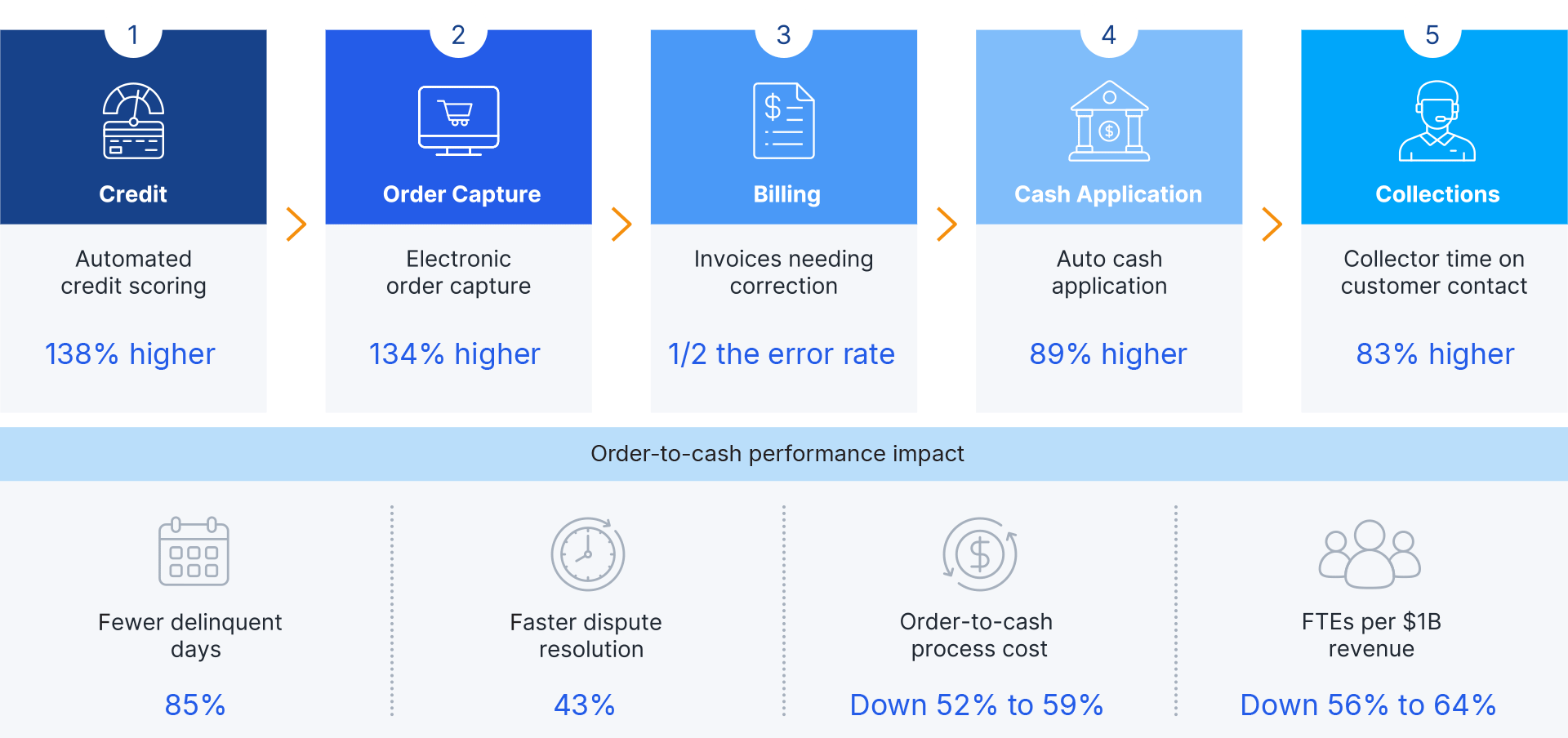
Gains compound across the order-to-cash process. Better decisions and data quality upstream reduce downstream effort, improving productivity, cash flow, and customer experience at every stage.
4 AI World Class Order-to-Cash benchmark modeling based on peer median and AI World Class performance scenarios, The Hackett Group®, 2026.
The economics begin to change at the front of the order-to-cash process. Automated credit scoring rises from 41% at the peer median to 97% at AI World Class performance levels.5 Higher-quality credit decisions that balance the market opportunity and risk reduce downstream collections efforts before an order is ever processed.
The share of orders received electronically more than doubles – from 29% at the peer median to 68% for AI World Class.6 As order quality improves, invoice corrections fall by roughly one-half, dispute resolution cycle time declines from 48 days to 27 days, customer experience improves through fewer billing errors and disputes, and cash application becomes increasingly autonomous.7
The impact is even more visible in collections. In the AI World Class subprocess, time spent contacting customers rises from 41% to 75% – roughly 83% more time spent contacting customers and nearly 60% less time spent preparing – allowing collectors to focus on relationship management, exception handling and cash performance rather than administrative work.8
This is not simply a productivity story. It is a redesign of the role itself and how that work is accomplished. Better data and AI-driven prioritization help collectors focus first on the accounts that matter most, reducing average days delinquent from nearly 10 days to approximately 1.5 days and improving working capital performance.9
5, 6, 7, 8, 9 AI World Class Order-to-Cash benchmark modeling based on peer median and AI World Class performance scenarios, The Hackett Group®, 2026.
AI transformation has moved beyond individual use cases
The opportunity extends enterprisewide
Order-to-cash illustrates a broader reality: Organizations that redesign work around AI are creating performance advantages of up to 75% across the enterprise.10
Spanning 16 end-to-end processes, AI World Class benchmarks identify where process reinvention can unlock the greatest improvements in cost, productivity, speed, quality and overall business performance.
The shift from isolated automation to end-to-end process redesign is already underway. In a recent Hackett AI XPLR® engagement, a software and services firm mapped its quote-to-cash process end to end, identified the highest-value automation opportunities, and rapidly prototyped AI and low-code solutions. The result was a 60% faster booking cycle.
In another example, a large warehousing and logistics company managing thousands of high-value contracts deployed AI agents across the contract-to-payment process. The agents extracted terms and entitlements from contract language, tracked milestone completion, identified unclaimed fees, monitored change orders, and validated performance fee eligibility. Payment processing time was 30% to 50% faster, and the system identified more than $20 million in potential annual revenue recovery.
10 AI World Class Order-to-Cash benchmark modeling based on peer median and AI World Class performance scenarios, The Hackett Group®, 2026.
How AI World Class quantifies opportunity
Organizations create value from AI in different ways – from targeted productivity improvements to end-to-end process transformation and operating model reinvention. The challenge for leaders is determining which opportunities will create the greatest value, what level of change is required and what performance improvements are realistically achievable.
AI World Class benchmarks answer those questions by quantifying opportunities at the process, subprocess and work-step level. The analysis is grounded in 30 years of benchmark data, process intelligence and transformation experience drawn from 98% of Dow Jones Global Titans, 97% of Dow Jones Industrials and 90% of the Fortune 100.
Unlike generic AI business cases, AI World Class benchmarks begin by validating current workflows, automation levels and operating environments before modeling future-state performance. This ensures opportunities are grounded in how work is actually performed rather than theoretical assumptions.
The outcome is a fact-based view of where AI can create value, what level of performance improvement is achievable and where investment should be prioritized.
Where finance leaders start
Closing the AI performance gap requires more than deploying new technology. It requires a disciplined approach to identifying where AI can create the greatest value, determining the level of change required and prioritizing investments that will deliver measurable business outcomes. Finance leaders pursuing process-led AI transformation typically begin with four steps.
- Establish the baseline. Benchmark current performance, workflows, and automation levels to quantify where the largest opportunities exist and which processes are most ready for transformation.
- Prioritize opportunities. Focus on the initiatives with the greatest potential impact, balancing performance improvement, expected return on investment (ROI), current technology footprint and implementation complexity. Leading organizations use benchmarks and process intelligence to rapidly validate assumptions, test high-value use cases and concentrate investment where AI can create the greatest business impact.
- Design the future-state operating model. Redesign end-to-end processes around desired business outcomes, defining how work should be performed, governed and measured in an AI-enabled environment. This includes decisions about process design, service delivery, governance, talent, organizational structure and where AI can most effectively augment, automate or orchestrate work.
- Build the transformation roadmap. Define the sequencing of initiatives, operating model changes, technology requirements and investment priorities needed to realize value at scale.
Let’s plan your next move, together.
The first wave of AI created an experimentation gap. The next wave is creating a performance gap. Organizations redesigning work around AI today are establishing new benchmarks for cost, productivity, cash conversion and operating leverage. The question is no longer whether AI will transform enterprise performance. It is how quickly organizations can capture that advantage.
The Hackett Group® combines proprietary process and performance intelligence, AI-powered platforms, and expert-led execution to help enterprises accelerate transformation and achieve measurable ROI.
It’s time to act. Contact us for more information or to schedule a demonstration.
Related Insights

The Process Mining Value Gap
Process mining provides unprecedented visibility into how work gets done. But many organizations now face a new challenge: hundreds of…

A Record $1.94 Trillion Working Capital Opportunity Demands a New Playbook
Despite stronger revenue and profitability, the working capital performance gap among North America’s largest companies rose 12% to a record…

Spend Analytics Solutions
Spend analytics solutions provide a single view into all historic, current and planned spending to give the perspective needed to…

Making AI Pay Off in Finance
At a recent executive roundtable hosted by The Hackett Group® in London, senior finance executives from a cross-section of industries…