
Beyond CLM: Why Third-Party Risk and Contract Management Must Operate as One
Contract management and supplier management are critical aspects of the source-to-pay (S2P) process, and there is significant overlap between the two, as both supplier information and risk are relevant to the contracting process. Moreover, contract details are relevant to supplier management, as contracts contain information that, when leveraged optimally, reveals the keys to success for the entire relationship with the counterparty.
For organizations operating under significant compliance obligations, such as GDPR, DORA or PCI-DSS, this overlap carries particular weight. A supplier cannot be contracted with, and spend cannot flow, until that supplier has been assessed and approved against applicable requirements. This elevates the integration of supplier management and contract management from an operational convenience to a compliance imperative, reframing the technology question accordingly.
However, from a technology standpoint, supplier management and contract management are often treated as distinct areas. Integrations between systems exist and can help lessen the information gap, but they are not always sufficient. Usually, these activities are managed by separate teams and in separate systems.
Where CLM falls short
Contract lifecycle management (CLM) software attempts to address these issues. Because it sits in the middle of the S2P process, it serves as the lynchpin of procurement software. However, in practice, CLM exists either as a module within S2P suites or as a standalone tool. When part of a suite, CLM can be relegated to a role as a poorly optimized aspect of a more spend-focused PO-centric product. In fact, the CLM module becomes a glorified repository in some cases. When CLM is a standalone tool, it is often more legal-focused. As a result, neither scenario optimally connects contract management to supplier management, especially with respect to risk and ongoing performance evaluation.
Compliance, adherence to obligations (especially financial obligations), and renewals are essential to smooth procurement processes. Only some of this can be fully achieved solely with CLM. Contract lifecycle management is not one-size-fits-all software, and it is far more powerful when used in conjunction with other data, such as pertinent information from supplier management systems.
The risk of siloed contracting
Managing contracting as an isolated process can actively invite risk. Suppliers can enter the contracting workflow with less prior screening. As a result, legal teams may end up negotiating terms with counterparties whose risk postures are unknown, and obligations agreed to in the contract can go unmonitored after signature.
The midmarket challenge
Large enterprises are better resourced to combine CLM with other S2P software, even if this does not always solve the challenges. Midmarket companies do not always have this luxury – and this is especially true for midmarket organizations in highly regulated industries where supplier compliance frequently functions as a nonnegotiable precondition for doing business at all. These organizations in particular face the same challenges as large enterprises, but with increased compliance burdens and smaller teams with near-unmanageable workloads (sometimes even just a single person managing over 300 suppliers).
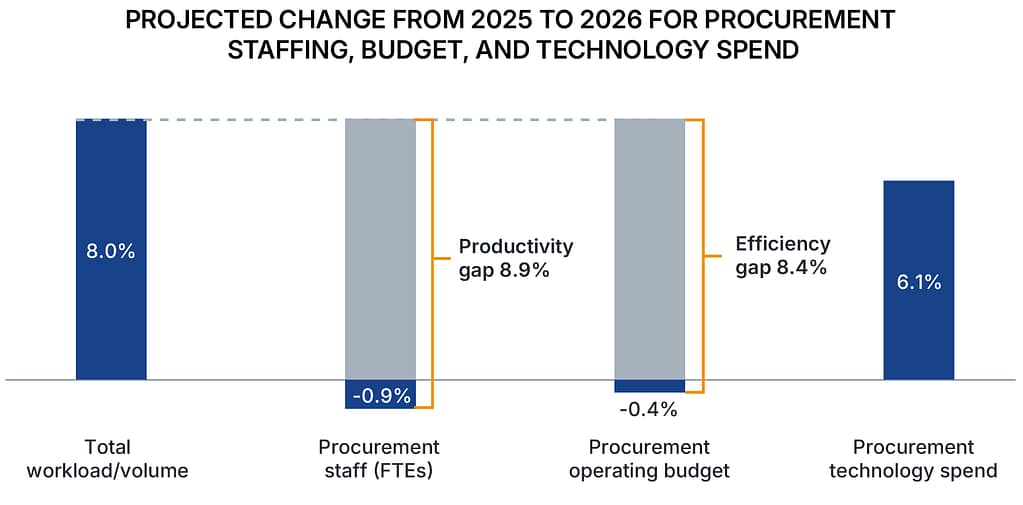
Our research supports this trend at a broader level (Fig. 1). In 2026, we expect procurement’s workload to increase by 8%, but without a corresponding increase in headcount or operating budget. In fact, we expect both procurement staff and operating budgets to decrease this year despite increases in workload. This only further highlights the need for technology to cut into this gap and improve efficiency.
FIG. 1 Procurement’s workload is predicted to increase by 8% in 2026, with a small decrease in both headcount and operating budget
The expanding compliance perimeter
This operational pressure coincides with a rapidly expanding compliance perimeter. Regulations such as DORA, NIS2 and the EUʼs corporate sustainability due diligence directive (CSDDD) are extending third-party risk management obligations well beyond GDPR, requiring organizations to demonstrate active, documented and ongoing due diligence across their supplier bases, not merely at the point of onboarding. For midmarket organizations already stretched thin, meeting this bar through manual processes or disconnected point tools is increasingly untenable. This compliance burden compounds over time and is magnified by an ever-increasing regulatory environment.
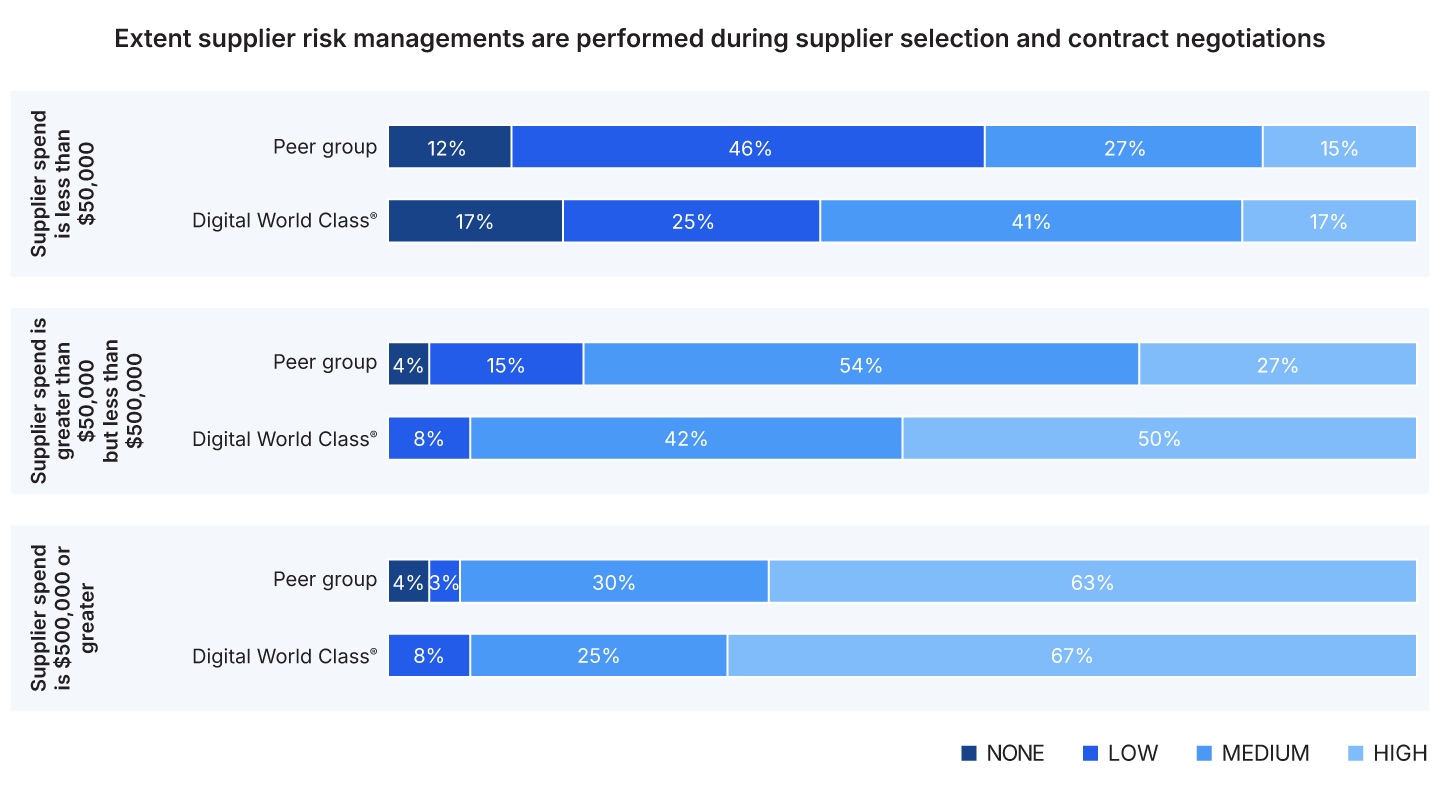
Digital World Class® organizations embed supplier risk assessments more consistently during supplier selection and contract negotiations, especially as spend increases (Fig. 2). This highlights the importance of integrating CLM with supplier risk management and broader supplier management capabilities. When risk assessments are embedded directly into the contracting workflow, organizations ensure that risk insights actively inform contract terms, controls and approval decisions, rather than being performed in isolation (if at all). This integration allows for stronger governance, more risk-appropriate contract structures, and greater consistency in managing supplier risk.
FIG. 2 Supplier risk assessments during supplier selection and contract negotiations
Why existing options do not adequately fit the midmarket
While many procurement software options offer some aspects of CLM and supplier management, very few have robust solutions in each area that are strong enough to stand alone (if desired). S2P suites can do this, but they are generally far more useful when additional modules are added (e.g., sourcing, spend analytics, procure-to-pay), which can be cost-prohibitive for a midmarket organization. And even with a full S2P suite, achieving this heightened level of value from the CLM and supplier management modules is far from a guarantee.
For this type of organization, traditional CLM is insufficient. Insights from contracts alone can be useful, but as mentioned, they are made more powerful when combined with other relevant data. Thus, what could really benefit a highly regulated midmarket organization is software that combines the value of CLM with supplier management and third-party risk management.
What a unified approach looks like
With this approach:
- Intake details and risk data flow directly into the contract workflow.
- Templates and clause libraries keep negotiations within agreed commercial and risk boundaries, while still allowing nuance when truly needed.
- Post-signature, the contract lives on the same record as the supplierʼs risk profile and spend, rather than in a separate system that only legal departments see.
- Key obligations, SLAs and notice periods are extracted and tracked as live work rather than being buried in PDFs.
- When a renewal approaches, users can easily access performance, risk, spend and current terms together to ensure informed decisions.
- Risk monitoring continues post-signature – a supplier that passed screening months ago may look very different today due to a cyber incident, sanctions change or shift in subcontractors.
Agility and AI for smaller teams
Additionally, because this type of software is optimized for midmarket organizations with small procurement teams, it should be agile and leverage AI/automation to further increase efficiency. Best-of-breed CLM providers sometimes require over a year to implement. Instead, this type of solution should require only a few months to implement, with pre-built workflows, templates and AI agents that do not require the customer to hire external consultants.
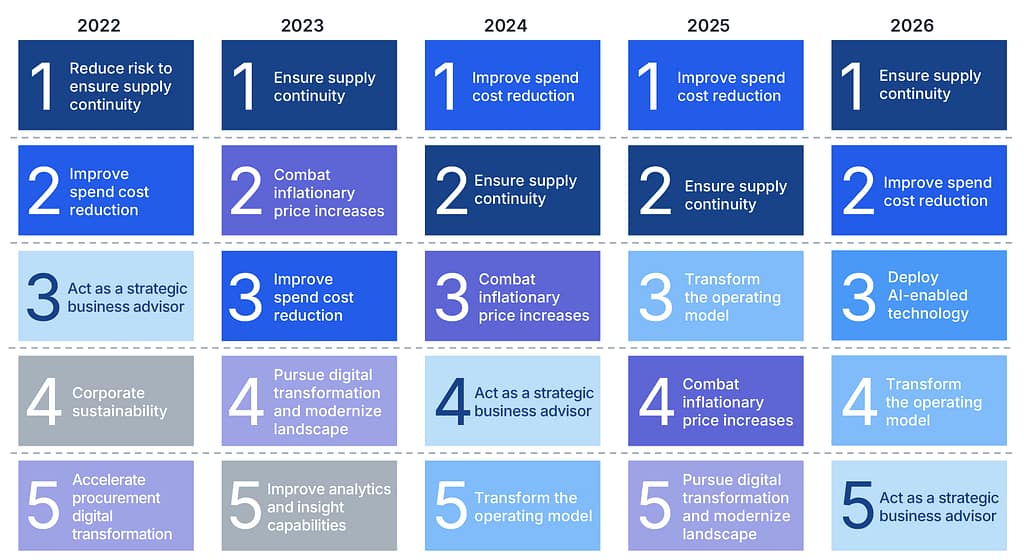
Our research also supports the marketʼs need for these functionalities. The desire to deploy AI-enabled technology was ranked as the third-highest priority for respondents in our 2026 Procurement Agenda and Key Issues Study (Fig. 3). This is a significant change from the past. While this option was not available as a response previously, the fact that it was the third most-selected priority out of dozens of options speaks to the importance of AI in procurement software today.
FIG. 3 Improving spend cost reduction and ensuring supply continuity have consistently featured in the top three priorities for procurement teams since 2022. Deploying AI-enabled technology was added in the 2026 study and entered the list in third position

Spotlight: An Integrated Approach to Supplier Risk, Compliance and Contracting
Gatekeeper is one of the only providers on the market that can address both CLM and supplier management pain points to such a high degree. As established, bringing these capabilities together provides even more value to customers. Traditional CLM solutions are more geared toward legal teams than procurement, and traditional supplier management solutions are too limited in scope to account for ongoing risks and deeper relationship insights that can be gleaned from contracts. Procurement organizations that want software to improve compliance benefit from this rare contract and supplier management combination, which is why Gatekeeper has had such success with this type of customer.
Agentic AI needs unified data
It is worth noting, however, that the effectiveness of AI agents is directly bound by the data they can access. An agent operating within a siloed CLM tool can only reason about contract data; one embedded in a standalone TPRM portal can only act on risk questionnaire responses. Agents that operate across a unified data model – with simultaneous visibility into risk assessments, contract terms, spend and performance signals – can drive categorically different outcomes. For example, they can flag a high-risk vendor before a contract is drafted, surface an obligation breach before it escalates into a compliance finding or identify a renewal cliff before auto-renewal locks in unfavorable terms. The value of agentic AI in third-party risk management is not simply a function of the sophistication of the model, it is a function of the completeness and unity of the data on which it operates. The unified data model provides the context, and it is the context that drives accurate agentic decision-making.
A purpose-built platform for compliance-driven midmarket
Organizations seeking this type of unified approach are increasingly finding it in a new class of purpose-built platform – one designed from the ground up for compliance-driven midmarket organizations, rather than adapted downward from enterprise S2P suites or expanded outward from legal-focused CLM tools. Gatekeeper is a strong example of this model in practice.
Traditional CLM solutions remain optimized for legal teams and redlining workflows; traditional supplier management tools collect questionnaires at onboarding and offer limited depth beyond that. Platforms like Gatekeeper represent a distinct approach: integrating risk-first intake, contract governance and ongoing performance oversight into a single data model that is purpose-built for organizations that require compliance.
Midmarket organizations that have small procurement teams rely on software to achieve desired outcomes efficiently. Gatekeeper supports this by its application of AI throughout the product, including agentic AI. Many of Gatekeeperʼs AI-based features would typically only be available in more expensive tools that exclusively target large enterprises, which is part of the platformʼs allure.
For example, Gatekeeper allows for quick and accurate summarizations of the key information, such as obligations, from individual contracts. Beyond this, Gatekeeper also supports more advanced agentic use cases that allow the platform to take action on behalf of the users in controlled settings, such as making approvals and sending emails on behalf of the organization to quickly gather more information from counterparties.
Customer perspectives
In conversations with two Gatekeeper customers, it was clear that the quick contract summary is a major value-add for organizations. The customers noted that any end user can now quickly understand a contract without involving the legal team, which saves significant time.
Another Gatekeeper customer mentioned that the supplier due diligence process used to be entirely manual and was not formally documented. It would involve countless emails and manual data entry into spreadsheets, but it was not always clear what the next step was because collaboration was limited. The current process is not only much faster, but it is also well-documented and organized for future reference.
Gatekeeperʼs customers also lauded the solutionʼs configurability and ease of use. When compared to other procurement software, end users prefer Gatekeeperʼs user interface. As a result, they are more likely to use the platform. In fact, one customer noted that his organization is also using Gatekeeper as a general platform/workflow tool, in large part because the configurability and user experience are far superior to the other existing options. Both Gatekeeper customers are also in the process of expanding AI use cases within the solution, whether for expedited contract reviews or negotiation support.
Interestingly, both Gatekeeper customers made a similar comment related to having needed a tool like Gatekeeper for years, long before they were aware it existed. This exact combination of CLM and supplier management/due diligence capabilities is rare, especially when packaged toward midmarket companies.
Related Insights

Beyond Savings: Can Your Organization Prove Procurement’s Full Business Value?
Traditional savings opportunities are becoming harder to find, yet procurement continues to create value across working capital, supply continuity, risk…

AP Automation/Invoice-to-Pay Solutions
Accounts Payable (AP) /Invoice-to-Pay (I2P) automation software is designed to streamline AP processes within organizations by automating the receipt, processing…

Carbon Management Solutions
Carbon management solutions are designed to assist companies in reducing their carbon footprint, usually taking into consideration the emissions of…

Contract Management Solutions
Contract lifecycle management (CLM) solutions are systems that automate the authoring, negotiation, execution, implementation, monitoring and renewal of B2B contracts…