
How AI Turns Integrated Business Planning (IBP) Into a C-Suite Imperative
Building smarter, faster and more strategic decision-making in the age of AI
Executives responsible for supply chain management face a planning environment unlike any in recent history. Supply chains remain vulnerable to geopolitical disruption. Tariffs and trade policies shift rapidly. Customer demand patterns are increasingly volatile. On top of all that, investors expect organizations to respond to uncertainty without sacrificing growth, profitability or cash flow.
Against this backdrop, many organizations are discovering a hard truth: the challenge is no longer a lack of data; it is turning data into effective decisions. This is why integrated business planning (IBP) has emerged as one of the most important disciplines in modern business and supply chain management. At its best, IBP serves as the operating system of the enterprise – a single, continuous process that aligns strategic objectives, commercial priorities, operational capabilities, financial commitments and resource constraints into one coherent plan.
Historically, organizations relied on sales and operations planning (S&OP) processes to balance supply and demand. While effective for operational coordination, traditional S&OP processes often stop short of connecting planning decisions to financial outcomes, strategic initiatives, workforce requirements, and executive priorities. IBP extends that framework by integrating all major business functions around a common set of assumptions and shared vision of the future.
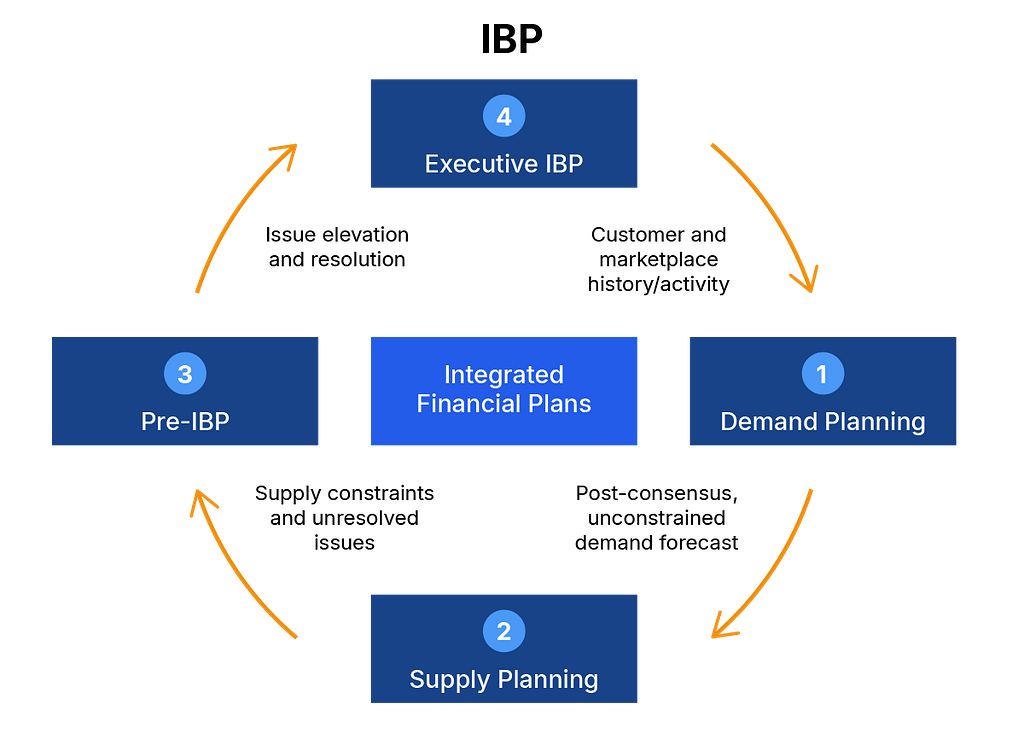
Artificial intelligence (AI) is accelerating this evolution. While much attention has focused on AI’s ability to improve forecasting, its greater value may be its ability to enhance decision quality, accelerate scenario evaluation and strengthen enterprisewide alignment.
The question for the C-suite is no longer whether to integrate planning. It is how quickly the organization can mature its IBP capabilities. While supply chain executives ranked IBP as a top five priority in The Hackett Group’s 2026 Supply Chain Key Issues Study, many expressed low confidence in their ability to meet this business need.
2026
Improve supply chain cost-efficiency
Enable supply chain digital transformation
Enhance product availability
Improve supply chain agility/resistence
Improve S&OP/IBP
What exactly is integrated business planning?
A useful way to think about IBP is this: Ask, “How can we ensure that every major decision is based on the same assumptions?” The answer is IBP. For many organizations, IBP has become the central planning process that connects every major function involved in supply chain management. Organizations familiar with the traditional S&OP process can think of IBP as its evolution – retaining the discipline of balancing supply and demand while extending planning across finance, commercial operations, product management, and executive decision-making.
Unlike the traditional S&OP process, integrated business planning is a cross-functional management process that aligns strategic, operational, and financial plans through a structured and recurring planning cadence. Rather than allowing each function to operate from its own forecasts, targets and assumptions, IBP creates a single planning framework that supports enterprise decision-making. In practical terms, it connects:
- Corporate strategy
- Financial planning
- Demand planning
- Supply planning
- Product and portfolio management
- Commercial planning
- Workforce and capacity planning
- Capital investment planning
The objective is not to create a perfect forecast. No forecast ever will be perfect. The objective is to ensure that the organization makes decisions based on a single agreed-upon view of reality.
Organizations that have successfully implemented IBP can produce a consensus plan with simultaneous views of:
- Units
- Cases
- Revenue
- Margin
- Cost
- Cash flow
- Working capital
This allows leadership teams to evaluate trade-offs with full visibility into both operational and financial consequences.
Why is IBP particularly important now?
Even organizations with mature S&OP processes are finding that three structural changes make IBP increasingly critical.
Volatility has become permanent. In the past, organizations treated disruption as an exception. Today it is the norm, making agile supply chain management a strategic advantage rather than simply an operational necessity. Executives must regularly respond to:
- Geopolitical instability
- Supplier disruptions
- Labor shortages
- Inflationary pressures
- Demand swings
- Extreme weather events
- Regulatory changes
Without integrated planning, it is too easy to respond with fragmented decisions that optimize one function while creating unintended consequences elsewhere. IBP provides the structure for evaluating disruptions across the entire enterprise.
Organizations must pursue growth and efficiency simultaneously. Historically, companies have prioritized either growth or cost optimization. Today’s environment requires both. Commercial leaders seek to expand market share. Finance leaders seek to protect margins. Supply chain leaders seek resiliency. Operations teams seek productivity.
Without a process for reconciling competing priorities, organizations frequently experience decision paralysis or functional conflict. IBP provides the governance framework needed to balance these objectives.
Investors expect predictability. Public companies are increasingly evaluated on their ability to consistently meet commitments. Forecast misses, inventory write-downs, margin surprises and cash flow volatility all damage credibility. IBP improves organizational predictability by creating earlier visibility into emerging gaps and enabling leadership teams to intervene before problems become financial outcomes.
How does the C-suite benefit from IBP?
Many organizations initially view IBP as an extension of the S&OP process. In reality, it is a decision-making process. For executive leadership teams, IBP creates four critical capabilities.
Strategic alignment. Strategy often fails not because it is flawed but because execution becomes disconnected from intent. IBP translates strategy into operational requirements. If a company intends to launch new products, enter new markets, improve service levels or reduce working capital, IBP quantifies what those goals mean for:
- Inventory
- Capacity
- Staffing
- Capital spending
- Supplier commitments
- Revenue expectations
This connection transforms strategy from aspiration to executable action.
Financial visibility. One of IBP’s defining characteristics is the integration of finance into the planning process. Finance is not merely validating plans after decisions are made. It becomes an active participant in evaluating options. This enables leadership teams to assess decisions in terms of:
- Revenue impact
- Margin impact
- Cash flow impact
- Return on investment
- Working capital implications
As a result, decisions become both operationally feasible and financially sound.
Faster decision-making. Traditional planning processes often involve weeks of reconciliation. Different departments bring different numbers. Meetings focus on debating assumptions rather than making decisions. IBP creates a common data foundation and governance structure that dramatically reduces this friction. This accelerates executive decision-making, thereby increasing organizational responsiveness.
Enterprise risk management. IBP functions as an early-warning system. Because the process regularly reviews demand, supply, financial performance and strategic initiatives, leadership teams gain visibility into risks long before they become crises. This allows proactive mitigation rather than reactive firefighting.
How does IBP help functional leaders responsible for day-to-day operations?
While senior executives benefit from improved strategic control, functional leaders often realize the most immediate gains. This is because IBP establishes a shared language across departments, promoting alignment. Commercial teams understand operational constraints. Supply chain teams understand growth priorities. Finance understands execution realities. Operations understands customer commitments. Instead of each function optimizing its own objectives, leaders optimize enterprise outcomes.
This reduces:
- Organizational conflict
- Redundant analysis
- Escalations
- Firefighting
- Last-minute surprises
The result is a more productive management culture and better business performance.
What improvements can you expect with IBP?
While outcomes vary by industry and maturity level, organizations with mature IBP capabilities commonly achieve improvements in four areas.
Forecast accuracy. Improved cross-functional collaboration and advanced forecasting capabilities typically increase forecast accuracy. More accurate forecasts lead to:
- Better inventory positioning
- Improved service levels
- Reduced obsolescence
- More efficient production planning
Inventory optimization. Inventory remains one of the largest consumers of working capital in many organizations. IBP improves visibility into demand and supply risks, helping organizations reduce excess inventory while protecting customer service.
Service performance. Organizations that align demand, supply and commercial plans are generally better positioned to meet customer commitments. Improved service performance often translates directly into stronger customer loyalty and revenue growth.
Cost reduction. More accurate planning reduces:
- Expedited freight
- Emergency sourcing
- Overtime labor
- Excess production
- Inventory carrying costs
These savings often create a compelling financial justification for IBP investments.
How is AI transforming integrated business planning?
In our 2026 Key Issues Study, 74% of enterprises reported implementing or piloting AI capabilities in their S&OP/IBP processes. This is one of the most common questions: What role should AI play? AI does not replace planning activities. Rather, it enhances nearly every stage of the planning process.
Smarter forecasting. Traditional forecasting relies heavily on historical patterns. AI can incorporate a much broader range of signals, including:
- Weather data
- Economic indicators
- Market trends
- Promotion effectiveness
- Social sentiment
- Search activity
- Customer behavior
This allows organizations to identify patterns that conventional statistical methods may miss. We’ve had discussions with organizations that report meaningful improvements in forecast accuracy through AI-enabled forecasting approaches.
Demand sensing. It shortens the time between market changes and planning responses. Instead of waiting for monthly cycles to detect demand shifts, AI continuously monitors signals and identifies emerging trends. This enables organizations to respond more quickly to changing conditions.
Real-time replanning. One of the most significant developments is the convergence of long-term planning and operational execution. Historically, IBP operated on a monthly cycle while execution occurred daily. AI helps bridge that gap. Organizations can increasingly adjust plans in near real time as conditions change. This improves responsiveness while maintaining alignment with strategic objectives.
Scenario planning at scale. Scenario analysis has always been valuable. The challenge was the time required to perform it. AI dramatically increases the number and complexity of scenarios that organizations can evaluate – and the speed with which they can ask and answer questions such as:
- What happens if demand rises 15%?
- What happens if a key supplier fails?
- What happens if tariffs increase?
- What happens if a product launch is delayed?
AI can rapidly evaluate these possibilities and quantify impacts across revenue, margin, service, inventory, and cash flow.
Decision intelligence. Perhaps the most transformative application of AI is decision intelligence. Rather than simply generating forecasts, AI can identify recommendations, quantify trade-offs and highlight risks. These capabilities shift planning conversations from: “What happened?” to “What should we do next?” That transition creates significant value for executive decision-makers.
What are organizations getting wrong about AI and IBP?
Despite growing enthusiasm, many organizations misunderstand the relationship between AI and planning. Three misconceptions are particularly common.
Misconception No. 1: Better algorithms fix poor processes. They do not. Organizations with fragmented planning processes often find that AI merely accelerates existing dysfunction. Planning discipline must come first.
Misconception No. 2: Technology increases alignment. Alignment remains a leadership responsibility. Technology can improve visibility and analysis, but only executives can resolve competing priorities and make enterprise trade-offs.
Misconception No. 3: Forecast accuracy is the primary goal. Forecast accuracy matters, but the ultimate objective is better business outcomes. An organization with a highly accurate forecast but poor decision-making will still underperform. IBP succeeds when better insights lead to better actions.
What’s required for a successful IBP transformation?
Organizations that achieve the strongest results typically focus on five foundational elements.
Executive ownership. IBP cannot be delegated exclusively to supply chain or planning teams. The process must be owned by the executive leadership team.
Financial integration. Finance must participate throughout the planning cycle, not only at the end. Financial integration is what differentiates IBP from traditional S&OP.
Governance and accountability. Clear decision rights are essential. Every participant must understand responsibilities, escalation paths, review schedules and performance expectations.
Data quality. AI and advanced analytics depend on trustworthy data, but data remains the primary barrier to AI adoption. In our 2026 Key Issues Study, one-half of supply chain leaders surveyed cited data quality as a major concern. Organizations must prioritize master data quality and planning data governance before pursuing advanced AI initiatives.
Continuous learning. The strongest IBP organizations treat planning as a learning system. They regularly evaluate:
- Forecast accuracy
- Assumption quality
- Decision effectiveness
- Business outcomes
This feedback loop drives continuous improvement.
How will AI change IBP and planning in the future?
The next generation of IBP will be characterized by continuous rather than periodic planning. AI-enabled systems will increasingly monitor markets, detect disruptions, recommend responses and automatically quantify impacts. Human leaders will remain central, but their role will evolve. They will spend less time gathering information and reconciling spreadsheets, and more time evaluating strategic choices, assessing risks, and making decisions.
Organizations that successfully combine disciplined IBP processes with AI-enabled decision support will create a significant competitive advantage.
Final thoughts
Integrated business planning has evolved from a supply chain process into an enterprise management discipline. It is now one of the primary mechanisms through which organizations translate strategy into execution, align functional priorities, manage uncertainty and improve financial performance.
AI is accelerating that evolution. Forecasts are becoming more accurate. Scenario analysis is becoming faster. Decision cycles are becoming shorter. Insights are becoming more actionable.
Yet, the most important lesson remains unchanged. Technology does not create alignment. Leadership does. Organizations that establish strong planning governance, integrate financial and operational decision-making, and leverage AI as an accelerant – rather than a substitute – will be best positioned to outperform in an increasingly volatile business environment.
Related Insights

AI Is Setting a New Standard for Supply Chain Performance
Demand volatility, tariff exposure and margin pressure are forcing supply chains to deliver more without proportional increases in resources. AI…

Supplier Management Solutions
Supplier management is the default methodology to manage the lifecycle of suppliers. So, ‘supplier management’ concerns itself with ‘supplier lifecycle…

The Hackett Group® – As Seen on CNBC
Leading the way in Gen AI solutions, we are redefining what Digital World Class® performance looks like and accelerating your…

Objective Intelligence for Buyers and Solution Providers
As artificial intelligence (AI) reshapes enterprise operations and the provider market grows more crowded, buyers need objective evidence of business…