
The AI Organizational Capability Gap
Process-led AI transformation is redefining workforce performance
Executive summary
- A new organizational capability gap is emerging between organizations that redesign hire-to-retire around artificial intelligence (AI) and those that simply automate human resources (HR) transactions. The next competitive advantage will be defined by how effectively organizations attract, develop, deploy and retain talent, not through technology adoption alone.
- Leading organizations are using AI to reinvent work, not just automate tasks. By redesigning end-to-end hire-to-retire processes and operating models, they are creating capacity for higher-value work and structural advantages in talent acquisition, workforce development, organizational agility and business performance that extend beyond traditional digital transformation.
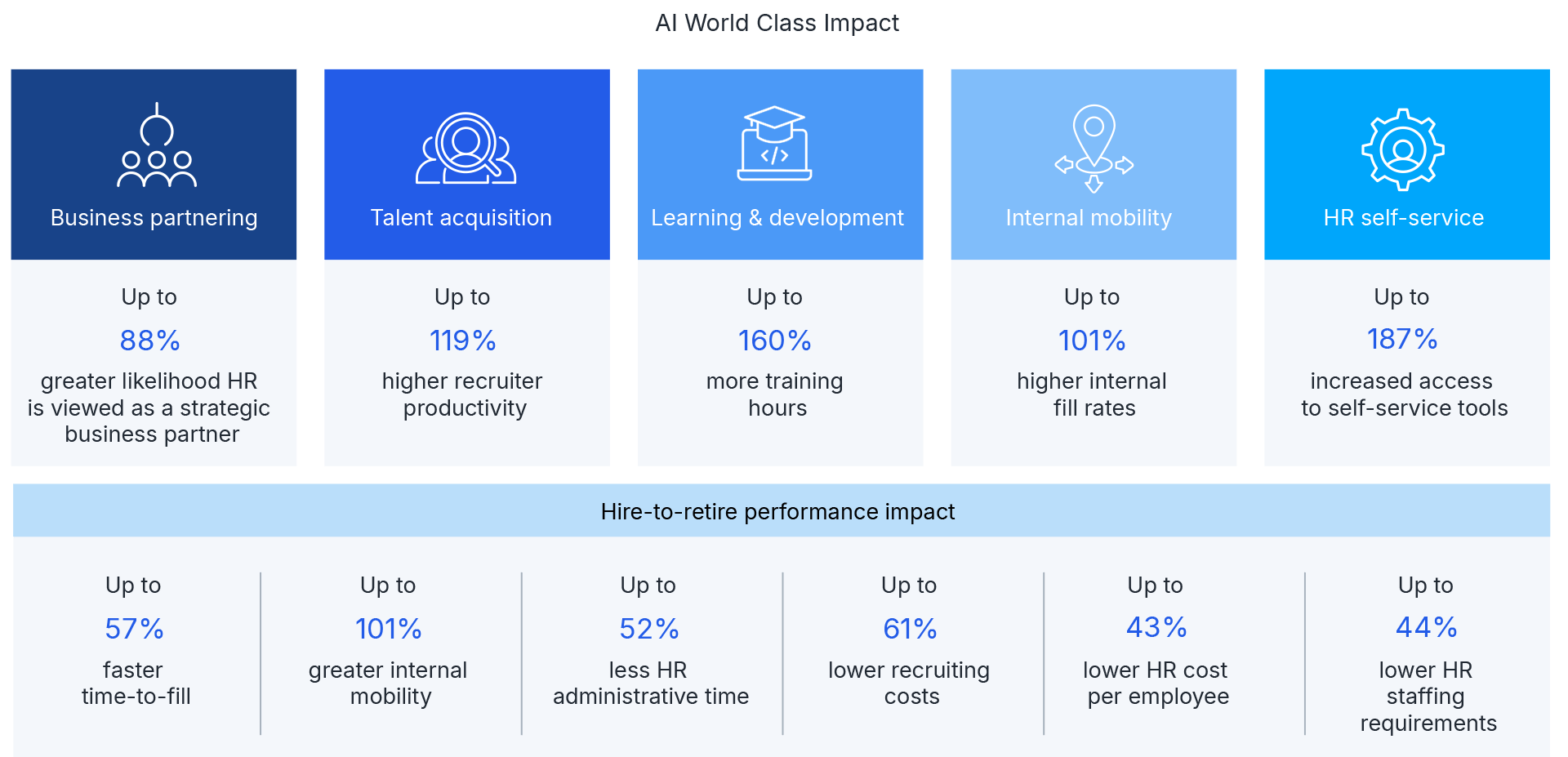
- Talent acquisition demonstrates the magnitude of the opportunity. AI World Class organizations – those redesigning end-to-end processes around AI-enabled execution – achieve up to 61% lower recruiting costs, 119% higher recruiter productivity and 57% faster time-to-fill by redesigning recruiting process leveraging AI.1
- The value compounds across the workforce lifecycle. Better hiring decisions, increased automation, improved workforce intelligence, and continuous skills development reinforce one another to strengthen organizational capability and workforce agility, dramatically improving internal mobility, learning effectiveness and HR’s ability to operate as a strategic business partner.
- The shift is already underway. Organizations are redesigning talent acquisition, automating workforce processes and using AI to enable HR teams to free up capacity to focus on higher-value strategic and business partnering activities.
Bottom line: The first enterprise AI adoption wave was primarily about experimentation and deployment. The next wave will be defined by performance as organizations redesign work around AI to create sustainable business advantage. The winners will be the organizations that redesign work first.
1 AI World Class Hire-to-Retire benchmark modeling based on peer median and AI World Class performance scenarios, The Hackett Group®, 2026
A new organizational capability gap is emerging between organizations that redesign work around AI and those that simply automate existing HR processes.
For decades, organizations competed for talent through employer brand, recruiting scale and workforce programs. Increasingly, they will compete through organizational capability – how quickly they can attract, develop, deploy and retain the talent needed to execute their strategy.
Leading organizations are redesigning hire-to-retire processes and operating models, using AI as a key enabler to create capacity for higher-value activities and achieve fundamentally different levels of workforce agility, talent mobility, employee development and organizational capability.
As organizations face continued pressure to improve productivity, accelerate growth and address persistent talent shortages, HR is increasingly expected to deliver more than just efficient service. Chief human resources officers are being asked to strengthen organizational capability, improve talent pipelines, accelerate skills development and help organizations adapt more quickly to changing business needs.
This elevates the role of HR. The challenge is no longer simply filling positions or administering workforce programs. It is determining how AI can create sustainable advantages in workforce productivity, talent effectiveness and organizational performance.
Yet most AI business cases remain focused on individual productivity improvements rather than workforce transformation, creating a growing collection of AI tools, copilots and automation technologies that improve isolated activities but do little to improve overall organizational capability. As AI investments accelerate, few organizations can clearly identify which workforce changes will create the greatest value, what level of performance improvement is achievable or where AI investment should be prioritized.
How AI value compounds across
the talent acquisition process
Talent acquisition provides one of the clearest examples of how AI creates enterprise value because improvements in sourcing, screening, hiring and onboarding reinforce one another across the recruiting process.
While many organizations focus on automating individual recruiting activities, AI World Class reveals a larger opportunity: redesigning the entire end-to-end talent acquisition process around AI.
Across candidate sourcing, screening, interview coordination, hiring and onboarding, improvements reinforce one another. Better decisions upstream reduce effort downstream, creating value throughout the process.
The results are significant. AI World Class modeling shows recruiting costs per hire can decline by up to 61%, while recruiter productivity improves by up to 119%. The time to fill positions drops by up to 57%.2
These gains are not driven by a single automation. They result from reimagining how work flows across the entire talent acquisition process.
2 AI World Class Hire-to-Retire benchmark modeling based on peer median and AI World Class performance scenarios, The Hackett Group®, 2026
How AI transforms the hire-to-retire lifecycle3
3 AI World Class Hire-to-Retire benchmark modeling based on peer median and AI World Class performance scenarios, The Hackett Group®, 2026
The opportunity extends beyond recruiting
The impact begins at the front of the talent acquisition process. AI World Class organizations automate significantly more recruiting activities, enabling recruiters to spend less time on administrative work and more time engaging candidates and hiring managers.
As sourcing, screening and scheduling become increasingly automated, recruiter productivity rises by up to 119%, recruiting costs per hire decline by up to 61%, and the time to fill positions drops by up to 57%.4 Faster candidate identification, screening and matching help organizations secure critical talent more quickly while improving hiring outcomes and reducing the business impact of open positions.
The benefits continue to compound after a hire is made. Better hiring decisions create stronger foundations for workforce development, internal mobility and long-term employee performance. As workforce data becomes more accessible and talent insights improve, organizations can identify skills gaps earlier, align development programs more effectively and prepare employees for future roles.
The impact becomes even more visible across the broader hire-to-retire lifecycle. AI World Class organizations achieve internal fill rates that are up to 101% higher and provide up to 160% more training hours, creating a more agile workforce that can adapt quickly to changing business needs.5 HR self-service automation increases by up to 187%, reducing administrative effort and creating capacity for HR teams to focus on higher-value activities.6 As a result, HR business partners spend up to 52% less time on administrative activities and up to 140% more time developing HR plans and facilitating organizational and leadership development.7
This is not simply a recruiting efficiency story. It is a redesign of how organizations attract, develop and deploy talent. As routine activities become increasingly automated, HR professionals can focus more time on workforce planning, skills development and organizational effectiveness rather than administrative work. The result is a more capable workforce, stronger talent pipelines, expanded organizational capability and improved business performance.
4, 5, 6, 7 AI World Class Hire-to-Retire benchmark modeling based on peer median and AI World Class performance scenarios, The Hackett Group®, 2026
AI transformation has moved beyond individual use cases
The opportunity extends enterprisewide
Hire-to-retire illustrates a broader reality: Organizations that redesign work around AI are creating performance advantages of up to 43% across the enterprise.8
Spanning 16 end-to-end processes, AI World Class benchmarks identify
where process reinvention can unlock the greatest improvements in cost, productivity, speed, quality and
business performance.
A large healthcare organization redesigned its talent acquisition process using Gen AI and automation. By streamlining recruiting workflows and eliminating low-value activities, the organization reduced time-to-fill from 65 days to 35 days, eliminated dependence on external recruiters and realized cost savings benefits of over 2,000%.
The initiative automated and simplified recruiting activities, allowing talent acquisition teams to focus more time on candidate engagement, hiring decisions and workforce planning rather than administrative tasks. The result was a faster, more scalable recruiting model capable of supporting workforce growth while improving efficiency and candidate outcomes. More importantly, it enabled HR to redirect capacity toward higher-value talent activities rather than administrative work.
8 AI World Class benchmark modeling based on peer median and AI World Class performance scenarios, The Hackett Group®, 2026
How AI World Class quantifies opportunity
Organizations create value from AI in different ways – from targeted productivity improvements to end-to-end process transformation and operating model reinvention. The challenge for HR leaders is determining which opportunities will create the greatest value, what level of change is required and what performance improvements are realistically achievable. The opportunity extends beyond organizations that have yet to modernize HR; even highly automated organizations can create additional value by redesigning work around AI-enabled execution.
AI World Class benchmarks answer those questions by quantifying opportunities at the process, subprocess and work-step level. The analysis is grounded in 30 years of benchmark data, process intelligence and transformation experience drawn from 98% of the Dow Jones Global Titans, 97% of the Dow Jones Industrials and 90% of the Fortune 100.
Unlike generic AI business cases, AI World Class benchmarks begin by validating current workflows, automation levels and operating environments before modeling future-state performance. AI World Class reflects the performance potential of organizations that redesign processes, operating models and ways of working around AI rather than simply automating existing activities. It extends The Hackett Group’s Digital World Class® methodology to model the next generation of performance achievable through AI-enabled execution. This ensures opportunities are grounded in how work is actually performed rather than theoretical assumptions.
The outcome is a fact-based view of where AI can create workforce value, what level of performance improvement is achievable and where investment should be prioritized across talent acquisition, workforce development, employee services and workforce management processes. The result is greater confidence in where to focus transformation efforts to improve workforce productivity, accelerate skills development, strengthen organizational capability and increase business performance.
Where HR leaders start
Closing the organizational capability gap requires more than deploying new technology. It requires a disciplined approach to identifying where AI can create the greatest value, determining the level of change required and prioritizing investments that will deliver measurable business outcomes. HR leaders pursuing process-led AI transformation typically begin with four steps.
- Establish the baseline.
Benchmark current performance, workflows, and automation levels to quantify where the largest opportunities exist and which processes are most ready for transformation. - Prioritize opportunities.
Focus on the initiatives with the greatest potential impact, balancing performance improvement, expected return on investment, current technology footprint and implementation complexity. Leading organizations use benchmarks and process intelligence to rapidly validate assumptions, test high-value use cases and concentrate investment where AI can create the greatest business impact. - Design the future-state operating model.
Redesign hire-to-retire processes around desired business outcomes, defining how work should be performed, governed and measured in an AI-enabled environment. This includes decisions about process design, service delivery, workforce planning, talent strategy, governance and where AI can most effectively augment, automate or orchestrate work. - Build the transformation roadmap.
Define the sequencing of initiatives, operating model changes, technology requirements and investment priorities needed to realize value at scale.
Let’s plan your next move, together.
The first wave of AI created an experimentation gap. The next wave is creating an organizational capability gap. Organizations redesigning hire-to-retire around AI today are establishing new benchmarks for organizational capability, workforce agility and business performance.
The opportunity is clear. The question is how quickly organizations can capture that advantage.
The Hackett Group® combines proprietary process and performance intelligence, AI-powered platforms, and expert-led execution to help organizations accelerate transformation and achieve measurable business outcomes.
It’s time to act. Contact us for more information or to schedule a demonstration.
Related Insights

The Future of HR: How Oracle Is Putting Agentic AI to Work
On this episode of the Gen AI Breakthrough podcast, Harry Osle, Chief Human Resources Officer at The Hackett Group®, speaks with…

AI as a Force Multiplier: What CHROs Are Missing
The Talent Equation Podcast – AI investments deliver less value when employees lack the skills to use the technology effectively.…
Talent Acquisition Vendor Assessment – Summary Report
AI and automation are reshaping recruiting, but vendor capabilities and business impact vary widely. This report assesses 12 talent acquisition…
Talent Acquisition Vendor Assessment – Full Report
Choosing the wrong talent acquisition platform can increase cost, add complexity and limit recruiting impact. The full report shows how…